Fundamentals of filtered Rayleigh scattering for particle-laden flows
G.G.W. van der Wielen(1,2), N.J. Dam(1,2), N.G. Deen(1,2), C.J.M. Hessels(1,2)
1: Dept. of Mechanical Engineering, Eindhoven University of Technology, The Netherlands
2: Eindhoven Institute for Renawable Energy Systems, The Netherlands
DOI:
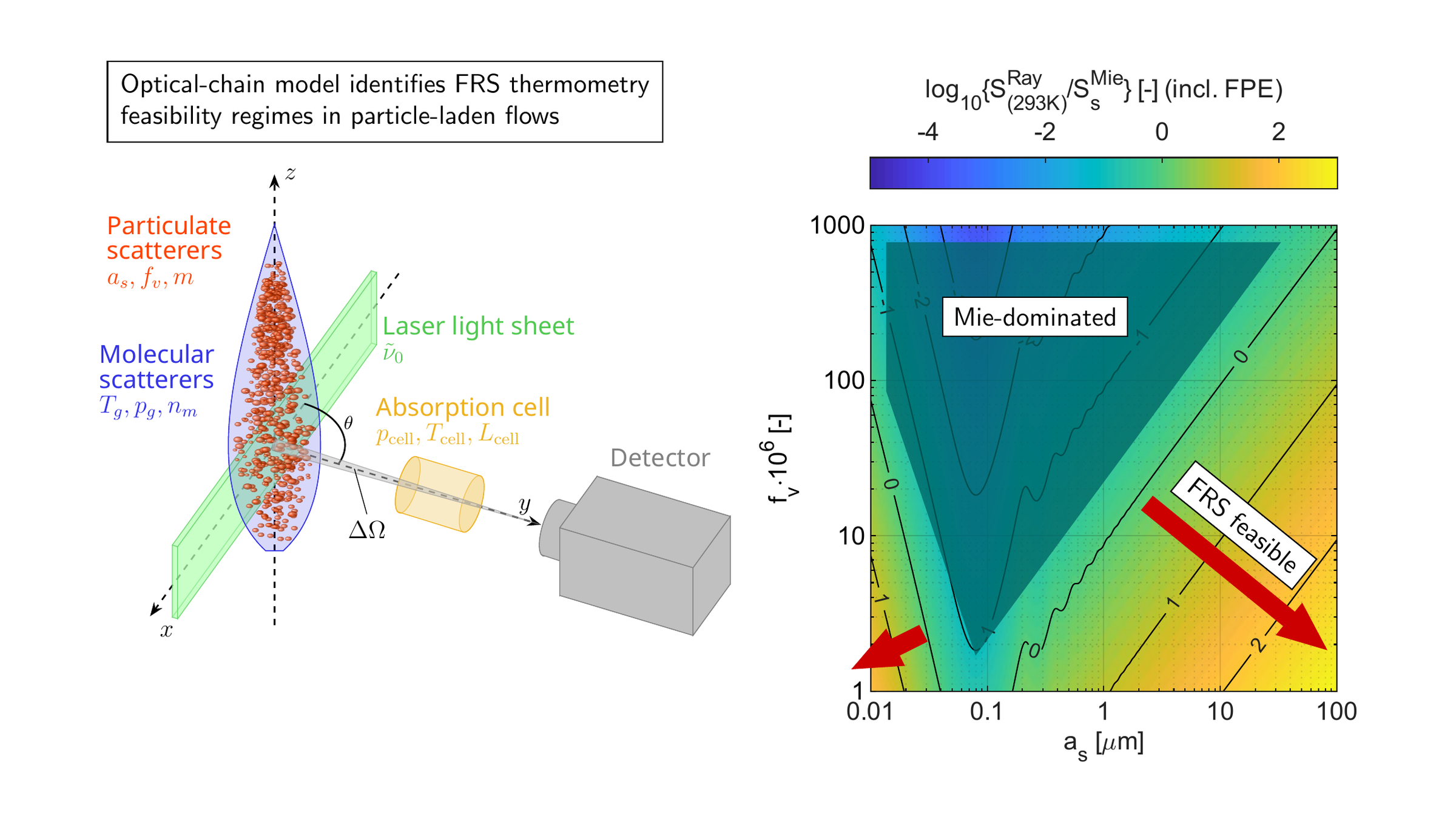
Laser-based gas-flow diagnostics in particle-laden flows are strongly affected by particulate Mie scattering, making conventional Rayleigh scattering impractical in many regimes. Filtered Rayleigh scattering (FRS) offers a route to recover molecular information by spectrally suppressing high-intensity particulate contributions. This work develops a general numerical optical-chain model to quantify when FRS becomes feasible in such environments, motivated by employing FRS thermometry in iron-powder flames. The model resolves and combines the laser lineshape, optional Fabry–Pérot etalon pre-filtering, vapour absorption filtering, particulate Lorenz-Mie scattering, and molecular Rayleigh scattering, and reduces the transmitted spectra to a detector-integrated signal ratio SgRay /SsMie as a practical design metric. Example calculations show that the feasibility boundary depends strongly on particle radius and volume fraction due to the residual broadband laser-pedestal light after absorption filtering. Improving spectral purity by means of an etalon upstream of the probe volume increases the signal ratio by more than an order of magnitude for representative settings, and thus identifies regimes of particle loading and size where FRS diagnostics in particle-laden flows are practically achievable.