Jet mixing optimization using Event-Based Imaging Velocimetry
L. Franceschelli(1), E. Amico(2), C.E. Willert(3), M. Raiola(1), G. Cafiero(2), S. Discetti(1)
1: Department of Aerospace Engineering, Universidad Carlos III de Madrid, Avda. Universidad 30, Leganés, 28911, Madrid, Spain
2: Department of Mechanical and Aerospace Engineering, Politecnico di Torino, Corso Duca degli Abruzzi 24, Turin, 10129, Italy
3: DLR Institute of Propulsion Technology, German Aerospace Center, Linder Höhe, Köln, 51170, Germany
DOI:
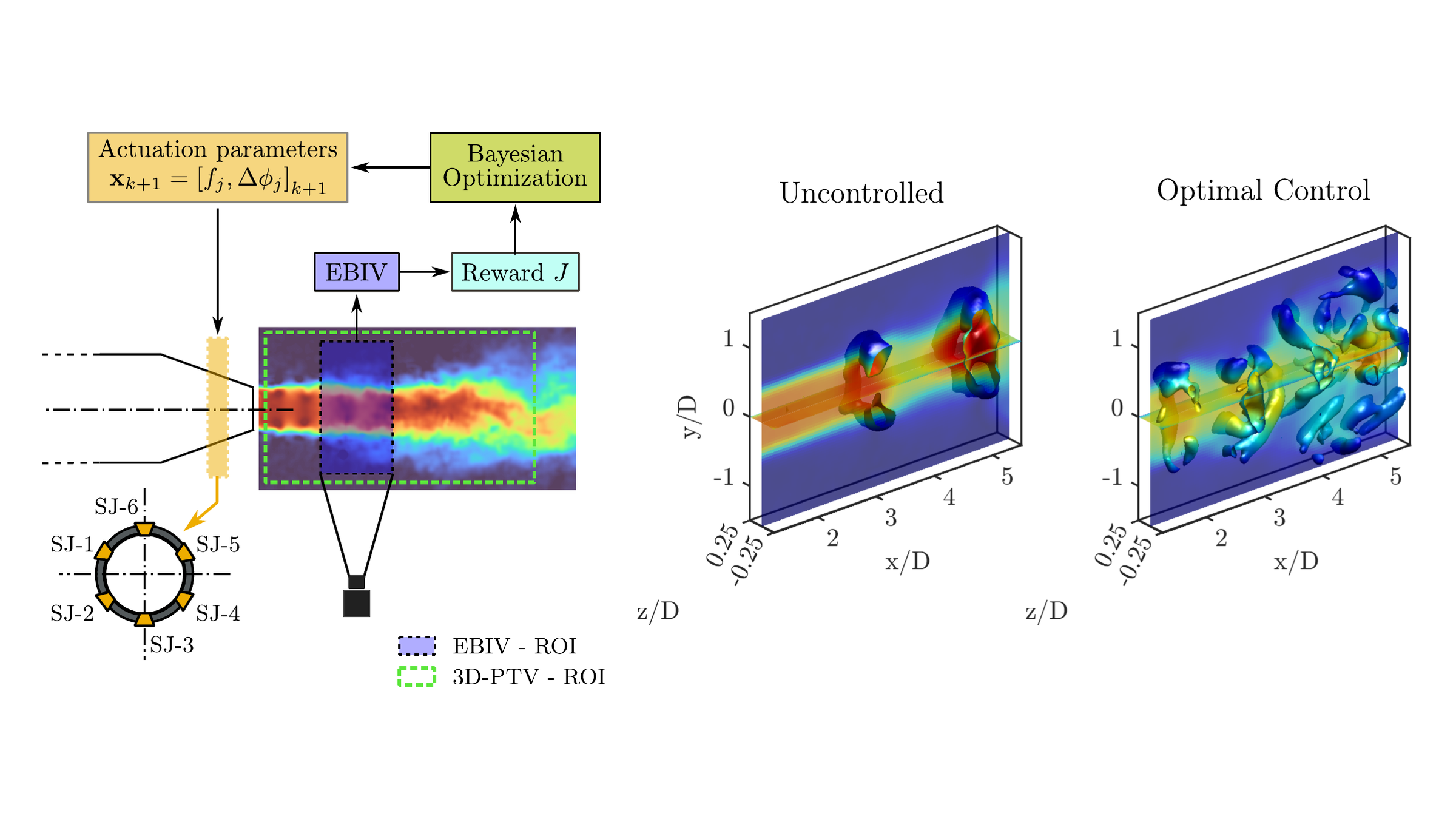
This contribution investigates the use of pulsed Event-Based Imaging Velocimetry (EBIV) as an in-the-loop sensor for experimental optimisation of open-loop control of a turbulent round jet. By leveraging the low latency, high dynamic range, and reduced data rate of event-based vision sensors under pulsed illumination, EBIV enables time-resolved planar velocity measurements with low-cost, non-intrusive instrumentation. The resulting spatially resolved velocity fields are used to define a mixing-related reward based on the turbulent kinetic energy averaged over a region of interest, enabling rapid evaluation of candidate forcing inputs beyond what is typically feasible with probe-based sensing. A Bayesian optimisation strategy is employed to tune the actuation parameters of six azimuthally distributed synthetic jets, while symmetry constraints are imposed to preserve observability in the EBIV measurement plane. The optimisation produces a consistent increase of the EBIV-derived reward and reveals clear performance trends with respect to the actuation Strouhal numbers and phase delays. The time-resolved planar fields enable a flow-physics analysis of the best-performing cases through mean-flow statistics, jet spreading and centreline decay, the coherent structures extracted by Proper Orthogonal Decomposition, and a low-dimensional embedding of the explored actuation space. Notably, defining the reward on the spatially averaged Turbulent Kinetic Energy decouples mixing enhancement from centreline-velocity decay, the latter being the surrogate commonly maximised by conventional jet-control optimisation. Volumetric 3D particle-tracking velocimetry is used only for an instantaneous, qualitative cross-check of the three-dimensional vortical organisation, with a systematic volumetric analysis left to future work.