Real-Time Event-Based Imaging Velocimetry for Closed-Loop Jet Control
L. Franceschelli(1), E. Amico(2), G. Scirè(2), C.E. Willert(3), M. Raiola(1), G. Cafiero(2), S. Discetti(1)
1: Department of Aerospace Engineering, Universidad Carlos III de Madrid, Avda. Universidad 30, Leganés, 28911, Madrid, Spain
2: Department of Mechanical and Aerospace Engineering, Politecnico di Torino, Corso Duca degli Abruzzi 24, Turin, 10129, Italy
3: DLR Institute of Propulsion Technology, German Aerospace Center, Linder Höhe, Köln, 51170, Germany
DOI:
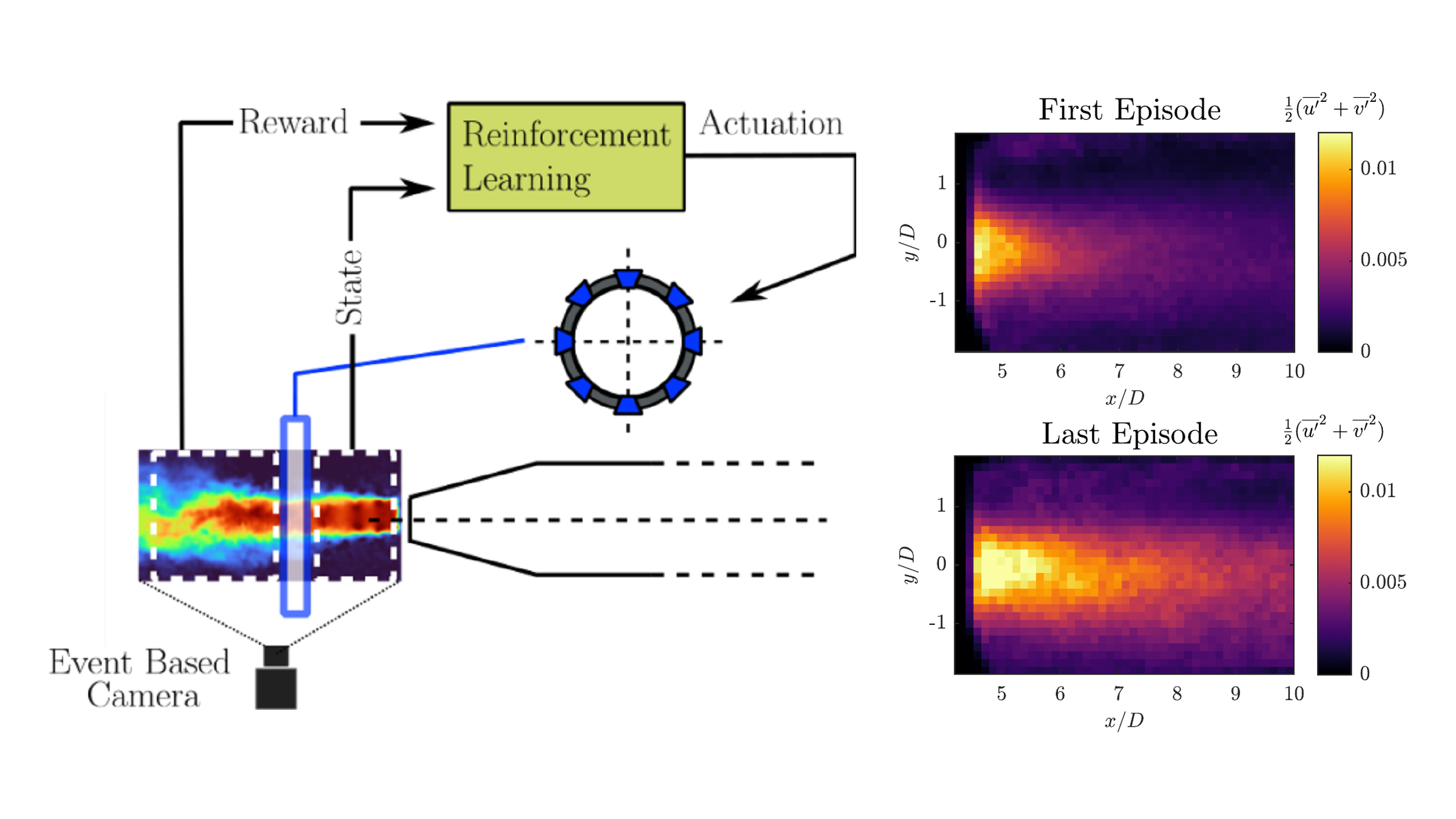
This work presents a closed-loop flow control framework in which real-time event-based imaging velocimetry (RT-EBIV) serves as the primary sensing modality, operating directly within the feedback loop at an effective velocity-field update rate of approximately 200 Hz. Spatially resolved velocity fields are reconstructed online from pulsed-illumination event data, providing simultaneous planar access to an extended region of the flow. This single spatially resolved acquisition is exploited to define, within distinct sub-regions of the same instantaneous field, both the state representation used for controller inference and the reward signal used for policy optimisation. This dual role would not be accessible to point-wise sensing approaches. The approach is demonstrated on the mixing enhancement of a submerged round water jet at a Reynolds number based on the bulk velocity and jet diameter ≈ 8000. The jet is actuated by pulsed radial jets injecting momentum into the shear layer. A compact state representation is constructed by projecting instantaneous RT-EBIV velocity fields onto a Proper Orthogonal Decomposition basis computed from unforced data, enabling high-frequency inference while suppressing measurement noise. Closed-loop control is implemented using the soft actor-critic algorithm, trained directly on the experimental velocity field to maximize the turbulent kinetic energy (TKE). The agent progressively learns actuation strategies that increase fluctuation-energy levels in the reward region, as confirmed independently by TKE distributions computed from time-averaged velocity fields. These results demonstrate the viability of RT-EBIV as a spatially resolved, real-time sensing modality for learning-driven closed-loop flow control, and validate the end-to-end sensing–decision–actuation pipeline under experimental and fully turbulent conditions.