The unsteady wall shear stress vector of a high Reynolds number turbulent pipe flow obtained with multi-aperture defocusing microscopic particle tracking
J. Klinner(1), C. Willert(1), L. Magnani(2), A. Tallamelli(2), G. Bellani(2)
1: Institute of Propulsion Technology, German Aerospace Center (DLR), Köln, Germany
2: Department of Industrial Engineering / CIRI Aerospace, University of Bologna, Forlı̀, Italy
DOI:
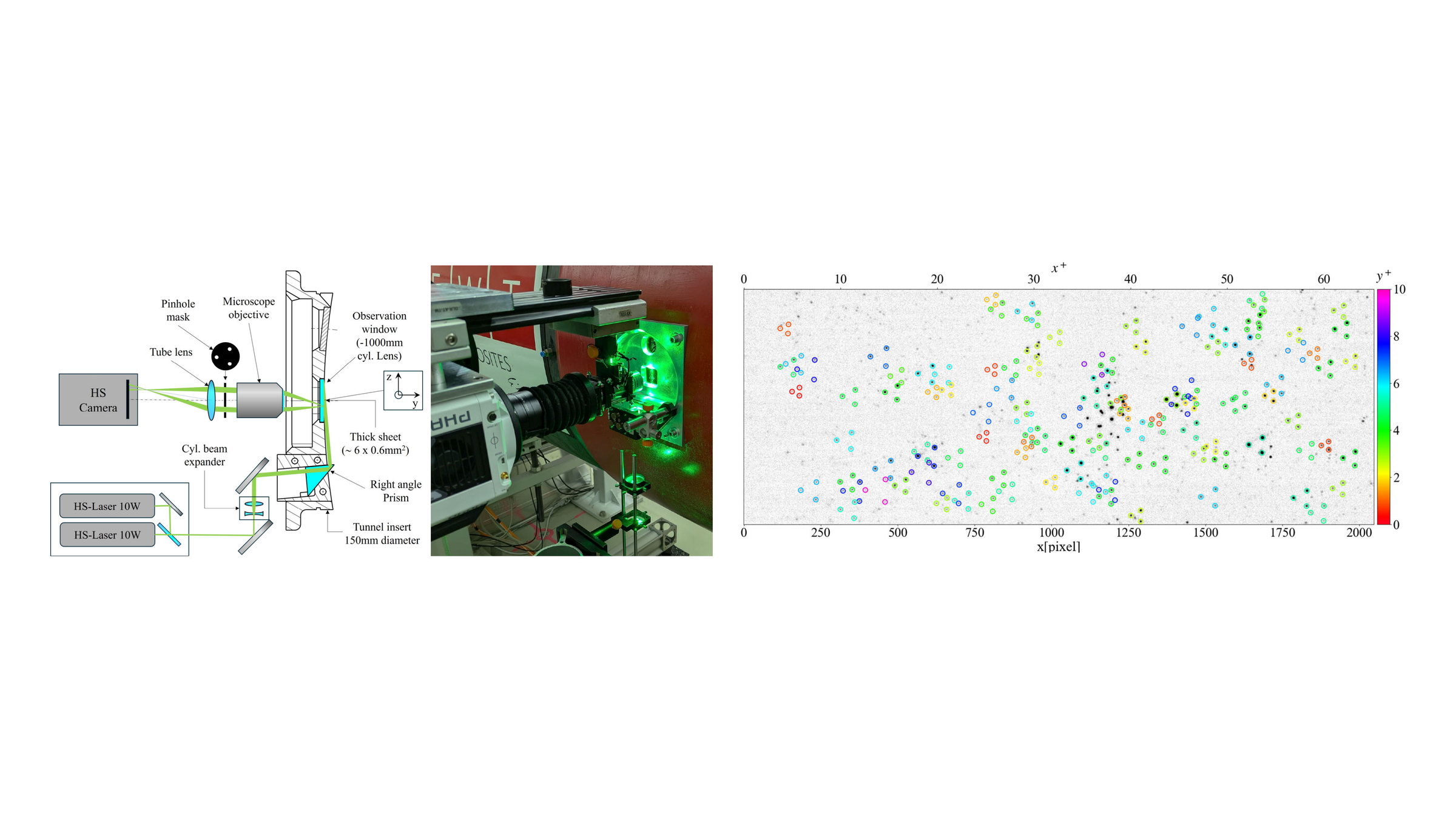
Three-dimensional particle tracking velocimetry (PTV) was performed in the turbulent boundary layer of the CICLoPE long pipe test facility using a single-camera, multi-aperture 3d 3c micro-PTV system (MA-μPTV). The distance of the tracer particles from the wall is encoded in the size of the imaged particle triplets, which are formed by a triple aperture in the optical path, following the defocusing principle originally introduced by Willert&Gharib 1992. In contrast to previously published MA-μPTV in a canonical turbulent boundary layer using a backscattering setup, the present configuration illuminates the particles from the side, enabling higher scattering efficiency and reducing light scattering from glass inclusions in the window. Thereby, the number density of successfully reconstructed particle triplets is approximately doubled, improving spatial resolution and statistical convergence. Extensive image data from the turbulent pipe boundary layer were recorded for centerline velocities of 5.5 ≤ ucl ≤ 30.1 m/s, with corresponding shear Reynolds numbers of 5900 ≤ Reτ ≤ 28 500. The recovered PTV data sets provide velocity statistics up to the fourth moment at wall distances up to 600 μm, resolving the near-wall turbulence peak. Both the streamwise and spanwise fluctuations of the wall shear stress (WSS) vector and the rate of change are computed from particle tracks in the viscous layer. The shapes of the joint probability distributions of the WSS fluctuations and accelerations show no significant dependence on Reynolds number. To the authors’ knowledge, this is the first unsteady WSS vector measurement at Reₜ up to 28 500. The lack of comparable DNS data limits comparisons to lower-Re correlations. While streamwise WSS fluctuations follow expected scaling with slightly differnt slope, spanwise components remain underestimated even after wall-distance extrapolation. In contrast, the spanwise component agrees with pipe flow \ac{DNS} data within measurement uncertainty, likely due to geometric confinement and suppression of large-scale spanwise coherent structures compared to flat plate flow.