Laser diode-based phosphor thermometry applied to high pressure hydrogen combustion
E. Laporte(1), S. Petit(1), R. Jalain(1), B. Fond(2), G. Pilla(1)
1: DMPE-LPA, ONERA, Université Paris Saclay FR-91123 Palaiseau, France
2: DAAA-MAPE, ONERA, Université Paris Saclay FR-91190 Meudon, France
DOI:
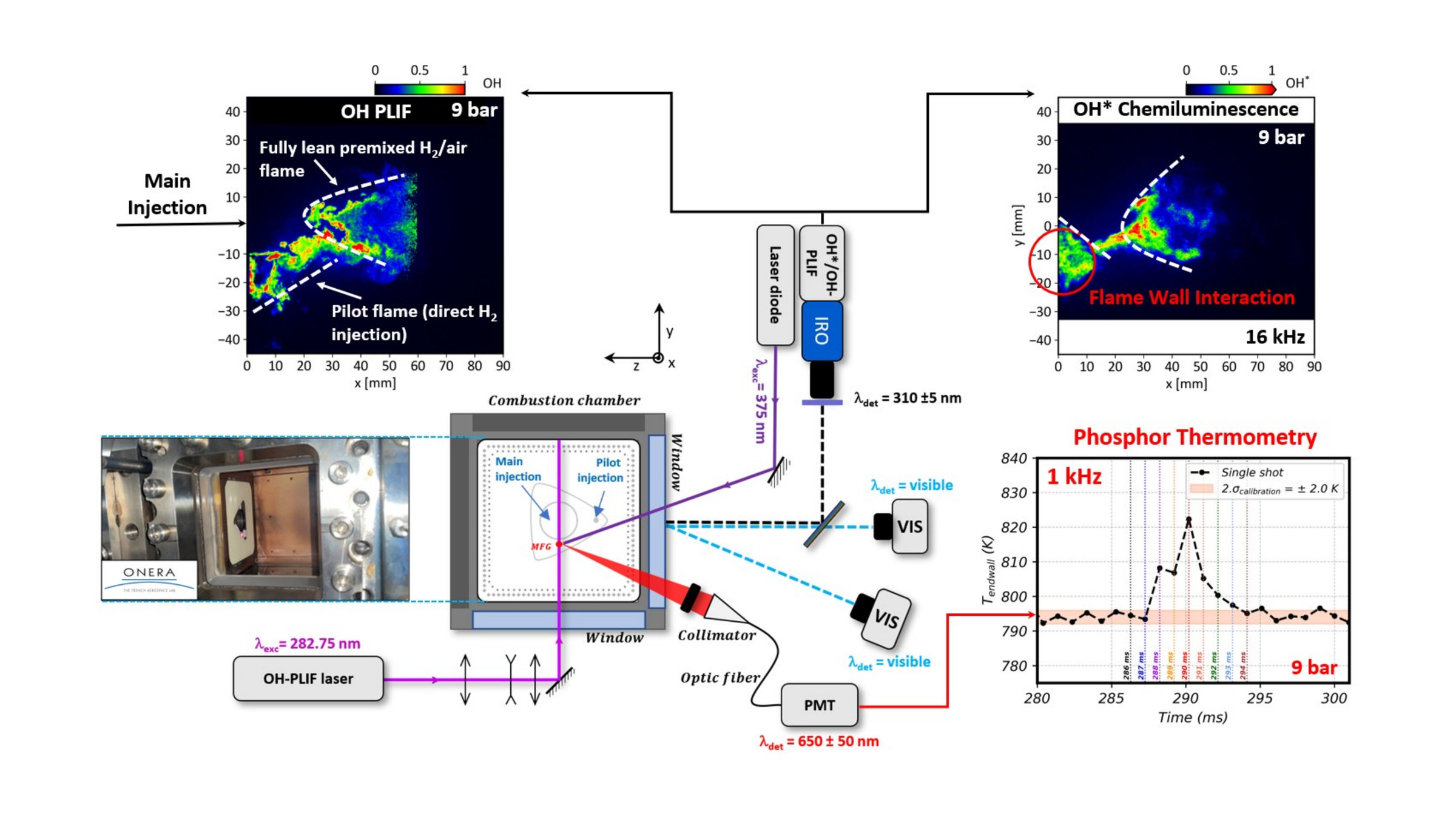
Kerosene substitution by hydrogen is promising to reduce aviation carbon footprint, but requires to design new combustion chamber architectures and injection systems. The specificities of hydrogen combustion could lead to increase wall thermal stress, due to fast transient events such as flashback (for premixed injection) and flame-wall interactions (FWI) (imposing unsteady wall heat fluxes up to several MW/m2). Therefore, experimental temperature measurements at high frequency rates are required to better understand the wall heat fluxes under such events. Lifetime-based phosphor thermometry (PT) is suitable for high frequency surface temperature measurements. With the current development of high-speed and affordable laser diodes, the development of laser diode-based PT setup is an opportunity to make high frequency measurements (≥ kHz) commonplace in combustion applications. In this work, using laser diode-based PT up to 1 kHz, we investigate the endwall thermal signatures associated with the flame dynamics for a new design of lean H2/air partially premixed injection for aeronautical applications. This design consists of generating a lean fully premixed swirled flame, stabilized with a pilot injection. The flame dynamics and topologies are characterized by high-speed OH* chemiluminescence and OH planar laser induced fluorescence (OH-PLIF), respectively. The tests are conducted on test bench MICADO at ONERA, allowing to conduct experiments at a chamber pressure up to 9 bar and an inlet air temperature above 700 K. Findings are presented for two different cases, i.e. fully premixed flame and partially premixed flame (pilot injection below 10% of the total hydrogen mass flowrate). In fully premixed conditions, the flame is lifted far from the endwall, and the heating effect of the flame is acceptable regarding thermal stress. However, flashback events can occur and lead to significant temperature fluctuations and wall thermal stress. In partially premixed conditions, significant temperature peaks are highlighted due to interactions between the pilot flame and the endwall, imposing wall heat fluxes above 5 MW/m2. This work demonstrates the feasibility of laser diode-based phosphor thermometry for high frequency measurements in high-pressure combustion.