Quantitative NO and Temperature Measurements in a Pulsed Laminar Hydrogen–Air Flame
C. Romero-González, C. Betrancourt, C. Mirat, L. Zimmer
Université Paris-Saclay, CNRS, CentraleSupélec, EM2C Laboratory, 91190, Gif-sur-Yvette, France
DOI:
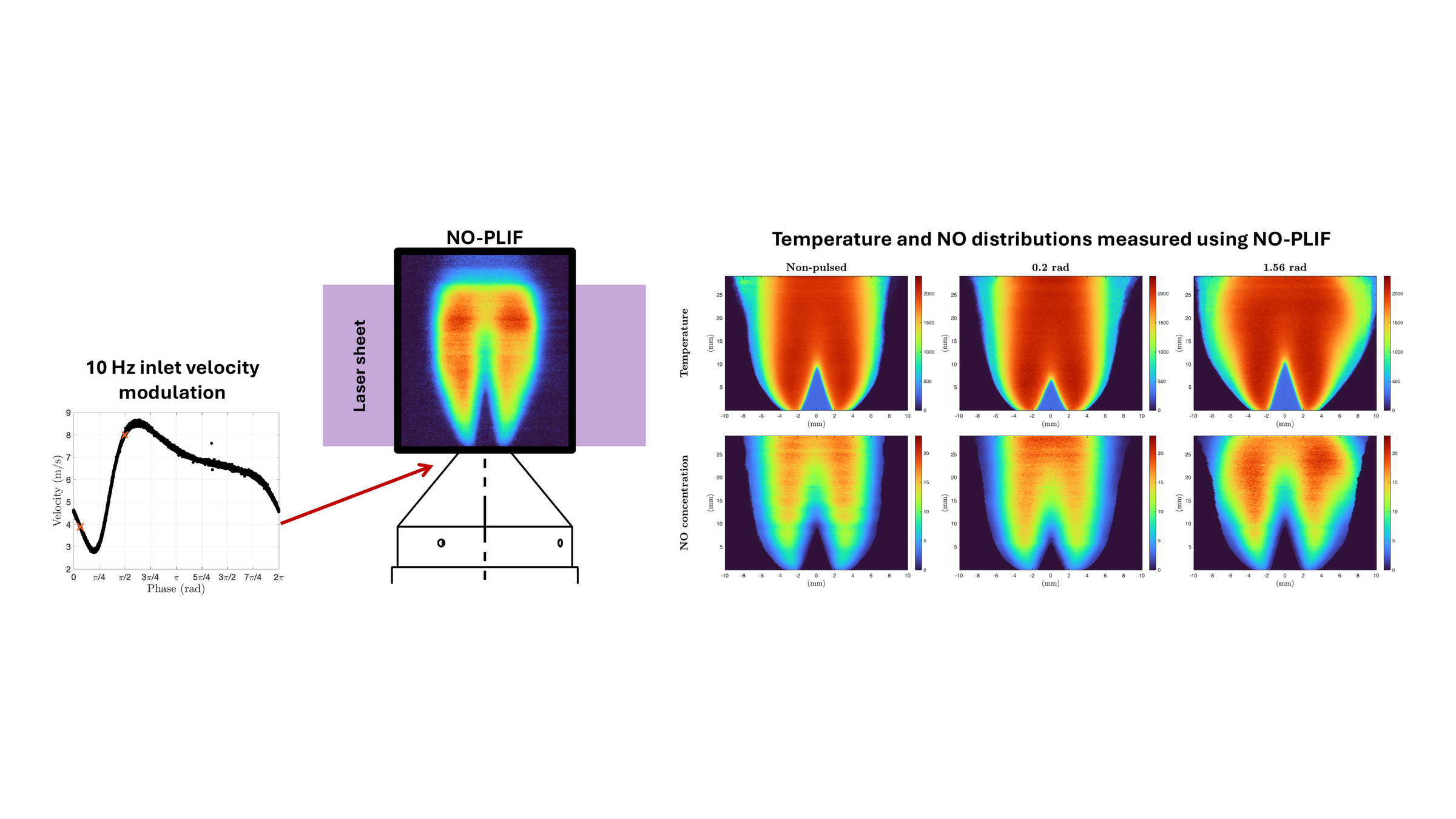
The transition to hydrogen as a carbon-free fuel introduces new combustion challenges, primarily nitrogen oxide (NOx) emissions driven by elevated flame temperatures. While nitric oxide laser-induced fluorescence (NO-LIF) is a well-established technique to study NO formation in steady flows, quantitative planar measurements in periodically pulsating environments remain limited. This work demonstrates phase-resolved, quantitative multi-line planar LIF (NO-PLIF) to map temperature fields and absolute NO concentrations in a pulsed, laminar premixed conical H2 -air flame (ϕ = 0.8). Controlled 10 Hz velocity modulations were introduced using a proportional valve. Temperature fields were resolved using multi-line NO-PLIF thermometry, while absolute NO fields were quantified on the Q2 +Q12 (27) transition calibrated via controlled NO seeding. Phase-locked measurements revealed that while local peak temperatures (∼2000 K) and peak NO levels (∼18 ppm) remain nearly identical between steady and pulsed conditions, significant structural widening occurs during the near-peak velocity phase. Area-weighted spatial integration shows that this widening increases the high-temperature reaction volume, driving the cross-sectional average NO concentration to be higher at mid-flame heights compared to the steady flame. These high-fidelity data provide a baseline for validating unsteady hydrogen combustion models.