Simultaneous 50kHz Schlieren and OH-PLIF Measurements of Shock-Induced Combustion in High-Mach-Number Flows
Y. Du(1,2), L. Wang(1), R. Luo(1,2), J. Xiong(1,2), X. Zhang(1), L. Yue(1,2), Q. Liu(1,2)
1: Institute of Mechanics, Chinese Academy of Sciences, China
2: School of Engineering Science, University of Chinese Academy of Sciences
DOI:
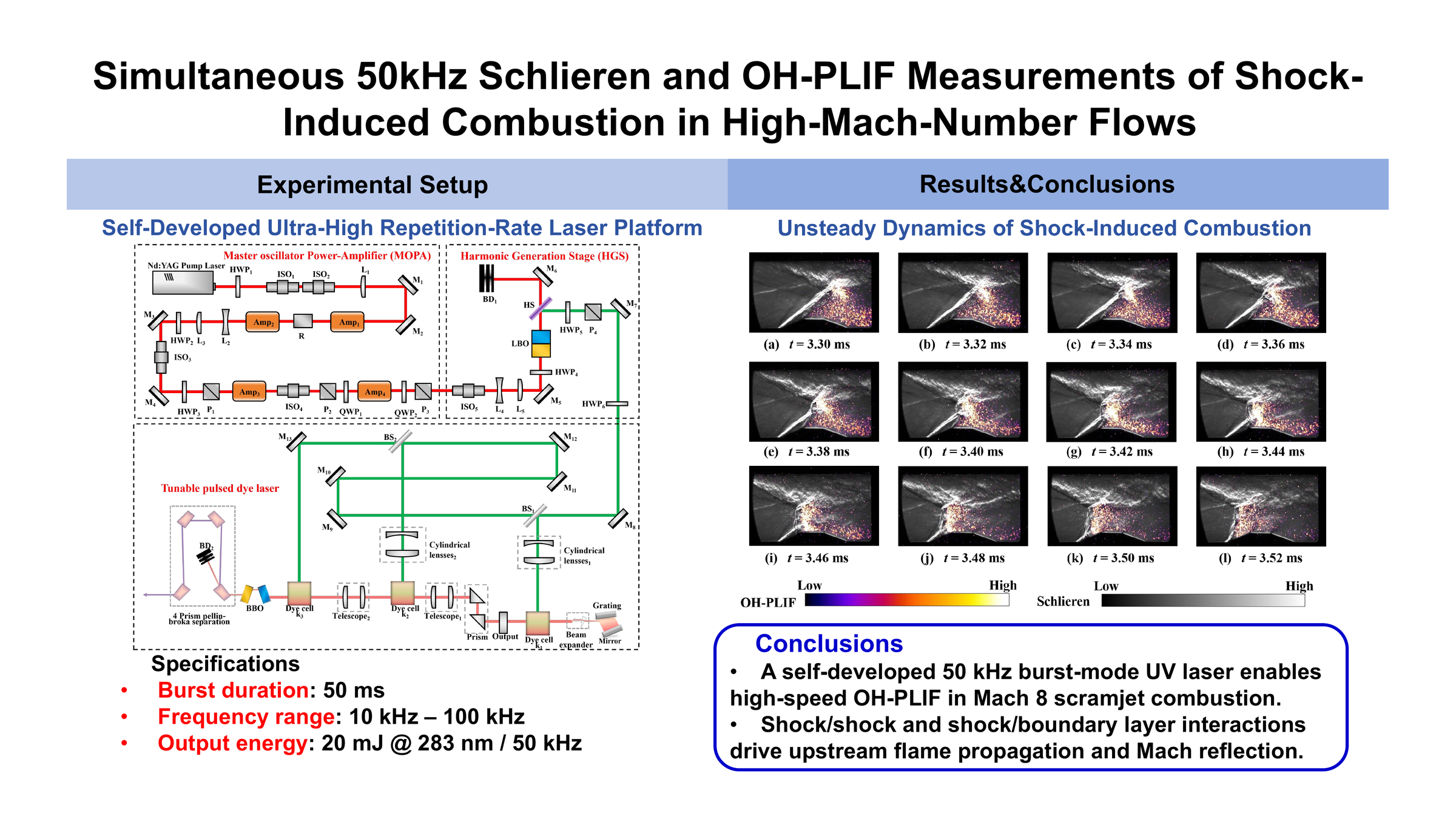
This study investigates shock-induced combustion within a scramjet combustor under a Mach 8 inflow condition. Direct-connect combustion experiments were conducted in a detonation-driven shock wind tunnel, with hydrogen injected into the combustor via struts. A wedge was employed to generate an oblique shock wave to induce combustion. Simultaneous high-speed schlieren and PLIF (Planar Laser-Induced Fluorescence) were utilized to resolve the flame structure and the underlying physical mechanisms of shock/shock and shock/boundary layer interactions. For OH-PLIF measurements, a self-developed high-repetition-rate burst-mode ultraviolet laser system was employed. This system features an intra-burst frequency of 50 kHz, a burst duration of 20 ms, and a temporal sequence of 1000 sub-pulses. It exhibits a power stability better than 0.79% over one hour, an intra-burst pulse energy uniformity of less than 0.86%, and supports continuous tuning over the wavelength range of 280 nm to 287 nm. These capabilities enabled OH-PLIF measurements under high-Mach-number (Mach 8) inflow conditions with a wind tunnel effective operating time of approximately 9.5 ms, achieving an acquisition frequency of 50 kHz. This provided critical insights for resolving the unsteady flame characteristics at high Mach numbers. In addition, pressure transducers mounted on the lower wall of the combustor provided time-resolved pressure data to complement the optical diagnostics. Experimental results reveal the unsteady characteristics of non-ideal detonation combustion within the combustor. It is observed that fuel combustion initiates within the high-temperature boundary layers, generating a separation shock wave. This separation shock wave subsequently interacts with the oblique shock wave from the wedge, leading to Mach reflection and promoting upstream flame propagation. The pressure data corroborate the optical observations, showing sequential pressure rises from the downstream to the upstream sections as the high-pressure region moves forward. Furthermore, the results indicate that the combustor length for shock-induced combustion ramjets should not be excessively long. An overly extended combustor allows the shock wave to continuously compress the incoming flow, significantly shortening the ignition delay distance of the fuel. Consequently, the fuel tends to auto-ignite within the boundary layer, which disrupts the stability of the intended shock-induced combustion mode and may lead to undesirable upstream flame propagation and potential engine unstart. Therefore, optimal combustor length is critical to balancing sufficient compression for ignition and avoiding adverse boundary-layer auto-ignition. Overall, this study provides insights into the transient dynamics of non-ideal detonation and offers practical guidance for the design of robust shock-induced combustion engines.