Evolution of Hydrogen Injection in Sub- and Super-critical Argon Environments
C. Chen, A.M.K.P. Taylor, Y. Hardalupas
Department of Mechanical Engineering, Imperial College London, UK
DOI:
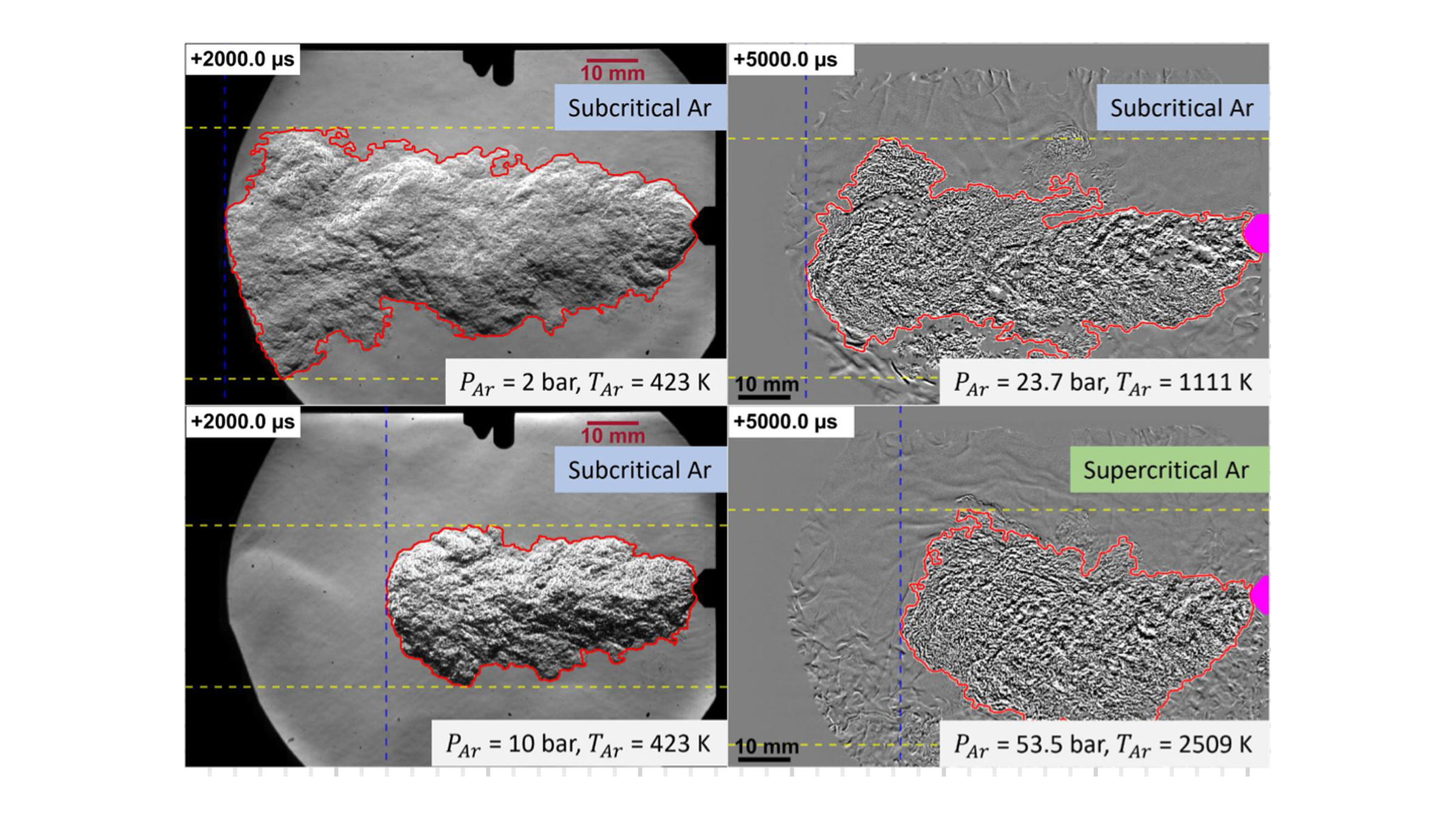
An experimental investigation of hydrogen injection in an argon ambient was conducted within a constant volume combustion chamber (CVCC), with the ambient spanning both subcritical- and supercritical-Ar conditions. The test condition matrix comprised low-pressure low-temperature (LPLT) Ar (2–10 bar, 423 K) and high-pressure hightemperature (HPHT) Ar (22.8–53.5 bar, 1111–2520 K) environments. H2 (150 bar, 423 K) was injected via an outwardopening hollow-cone injector under choked-flow conditions. Temporal evolution of the jet morphology was captured using Schlieren and quantified via axial penetration, jet width, jet area, and the width-to-penetration ratio as a metric for self-similarity. Under LPLT conditions, the jet transitioned from a near-field conical structure to an approximately cylindrical main body, with all spatial dimensions decreasing as chamber pressure increased; the penetration and width evolutions followed universal power-law correlations with time, while the width-topenetration ratio evolution universally decreased with time, converging to ~0.5 after 1.5 ms after start of injection (ASI). Conversely, the HPHT jet morphology assumed a more globally conical structure in the late injection stages. At identical ambient densities, non-reacting injections under supercritical-Ar ambient conditions exhibited 20% shorter axial penetration, 10% smaller jet width and 20% smaller jet area compared to HPHT subcritical-Ar ambient conditions. Combustion in supercritical-Ar environments only increased the jet width by ~10% after ASI = 2.5 ms with negligible impacts on penetration or area; in contrast, it enhanced all structural parameters for injections with subcritical-Ar ambient. The width-to-penetration ratio was independent of combustion for all HPHT conditions; while its evolution for injections with subcritical-Ar ambient was identical to LPLT results, it exhibited higher values for injections with supercritical-Ar ambient with a converged value of ~0.6 at larger ASIs. Ultimately, the heightened complexity of jet evolution under HPHT conditions precludes description of penetration and width evolutions by simple power-law scaling, highlighting the significant impact of the near-critical ambient conditions.