A quasi-real-time analysis of CPP fs-CARS spectra using Convolutional Neural Networks for temperature measurement
C. Bonnefoy, B. Barviau, A. Poux, F. Grisch
INSA Rouen Normandie, Univ Rouen Normandie, CNRS, Normandie Univ, CORIA UMR 6614, F-76000 Rouen, France
DOI:
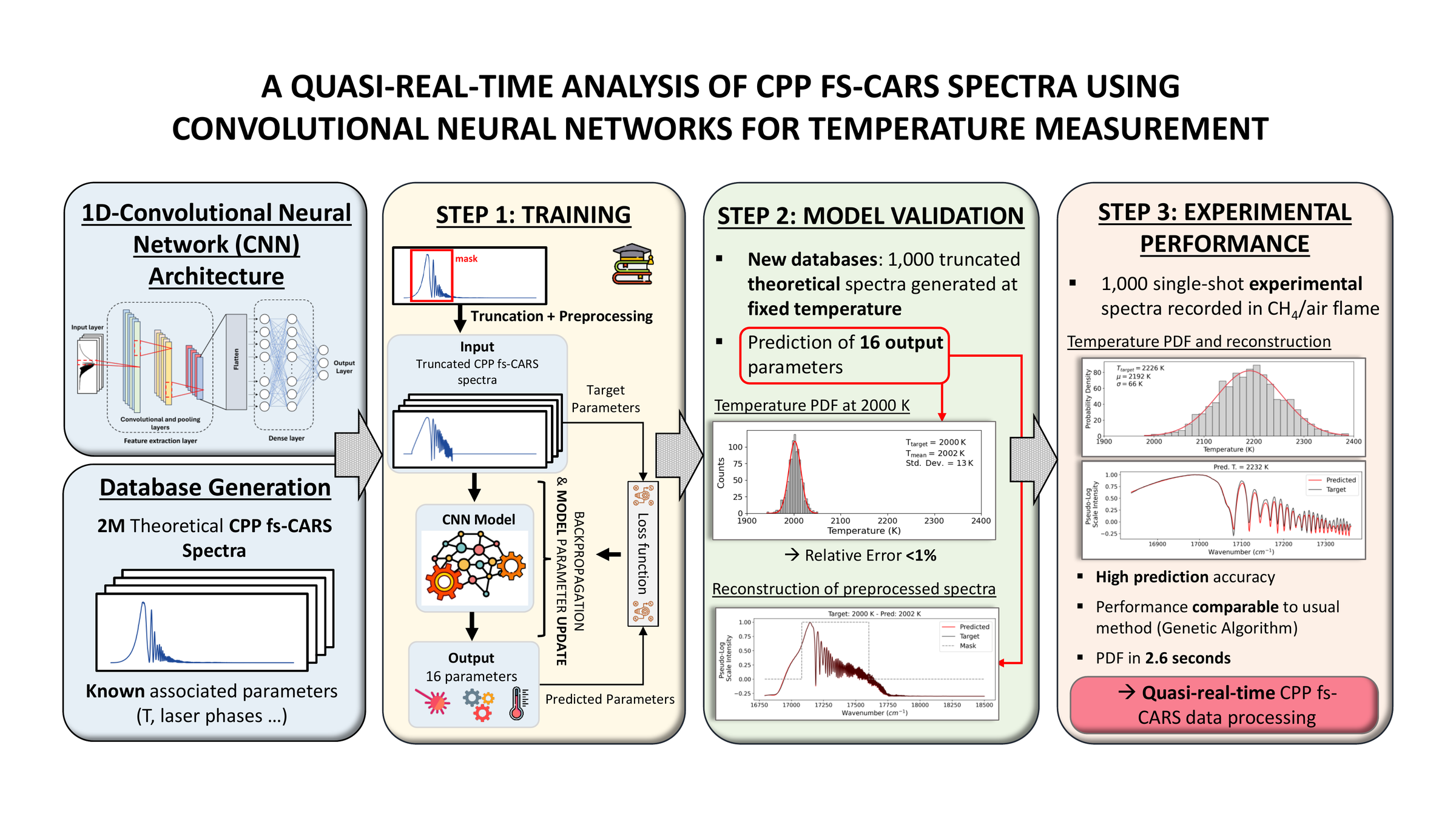
High-repetition-rate nonlinear optical diagnostics for combustion require high-speed data processing methods capable of handling large experimental datasets. A deep learning approach based on a one-dimensional convolutional neural network (1D-CNN) is proposed for the analysis of chirped-probe-pulse femtosecond coherent anti-Stokes Raman scattering (CPP fs-CARS) spectra. The objective is to directly infer temperature and relevant physical parameters from single-shot spectra without relying on iterative inversion methods. The model is trained and benchmarked in a supervised framework using a theoretical database of two million spectra generated from a detailed CARS physical model, including molecular rovibrational physics and laser pulse characteristics. A spectral truncation of the CARS theorical spectra is performed to reproduce realistic experimental spectral windows, and preprocessing is applied to homogenize simulated and experimental data. After training, the CNN is assessed on unseen theoretical spectra and on experimental measurements recorded in air and in a laminar CH4 /air flame at atmospheric pressure. Temperature retrieval demonstrates high accuracy in simulations and robustness under partial spectral information, with experimental temperatures remaining consistent with expected values. Reconstructed spectra from predicted parameters agree well with measurements, confirming physical consistency. Once trained, the network processes of thousands of spectra within seconds, providing several orders of magnitude speed-up compared to genetic algorithms. This enables near real-time analysis of CPP fs-CARS data and opens perspectives for diagnostics in turbulent reactive flows.