Experimental study of three-dimensional turbulent boundary layers in a simplified wing-body junction
A. Weingärtner, B. Ganapathisubramani
Department of Aeronautical and Astronautical Engineering, University of Southampton, United Kingdom
DOI:
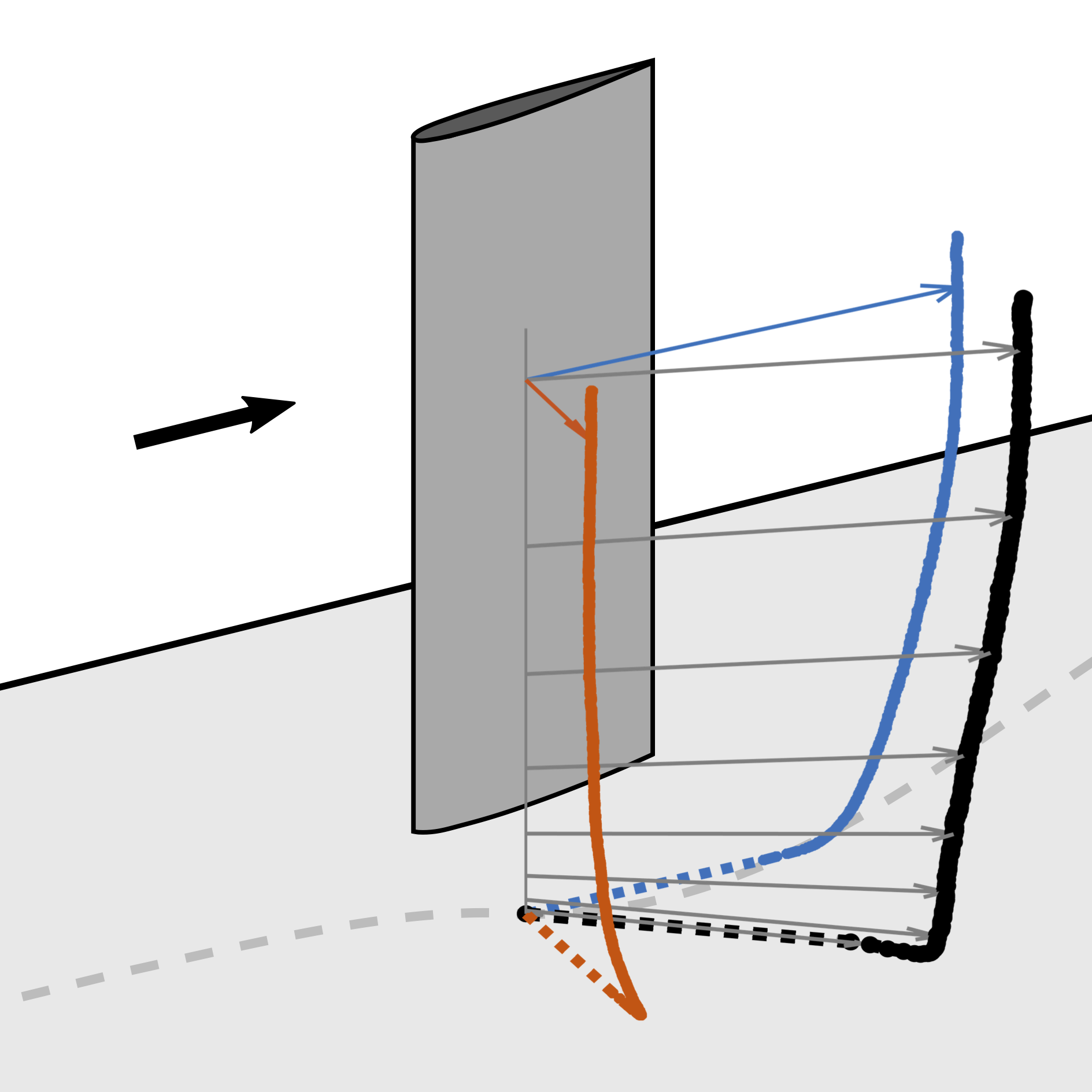
To date, the vast majority of fundamental boundary-layer studies have focused on twodimensional flow cases. In practice, however, such conditions are the exception rather than the norm, as most engineering applications are dominated by three-dimensional (3D) effects that strongly influence the flow physics. As a result, fundamental understanding of 3D turbulent boundary layers (TBLs) is still limited. A typical flow case that gives rise to 3D TBLs is a wing-body junction, which we investigated experimentally here. We present selected data from an experimental campaign, incorporating direct measurements of pressure, two-dimensional skin friction, and all three velocity components in closely spaced crossflow planes. Results show the expected pressure variation around the airfoil at a positive angle of attack and a significant impact onto the wall-shear stress (WSS) magnitude, especially near the wing's leading edge. For the limited data we show, the direction of the WSS is close to the angle of deflection of the freestream flow, but they are not equal in general. Furthermore, we show the skewed 3D TBL profiles along a spanwise plane near the leading edge. Results show a maximum in the spanwise velocity and hence the flow angle near the wall, which is likely related to the maximum in the WSS amplitude observed in that region. In the future, this combination of pressure, skin-friction, and velocity data is expected to be instrumental for testing and developing models to more generally describe 3D TBLs. Furthermore, it is known that the misalignment of stress and strain across the TBL is a major source of modeling inaccuracies, which we will assess based on the current data.