LDA-FFID coupled measurements of two-height canopy flow in a wind tunnel
V. Babin(1), L. Shig(2), A. Liberzon(2), Y. Bohbot-Raviv(1)
1: Environmental Wind Tunnel Laboratory, Israel Institute for Biological Research, POB 19, Ness Ziona 7410001, Israel
2: School of Mechanical Engineering, Tel Aviv University, POB 39040, Tel Aviv 6997801, Israel
DOI:
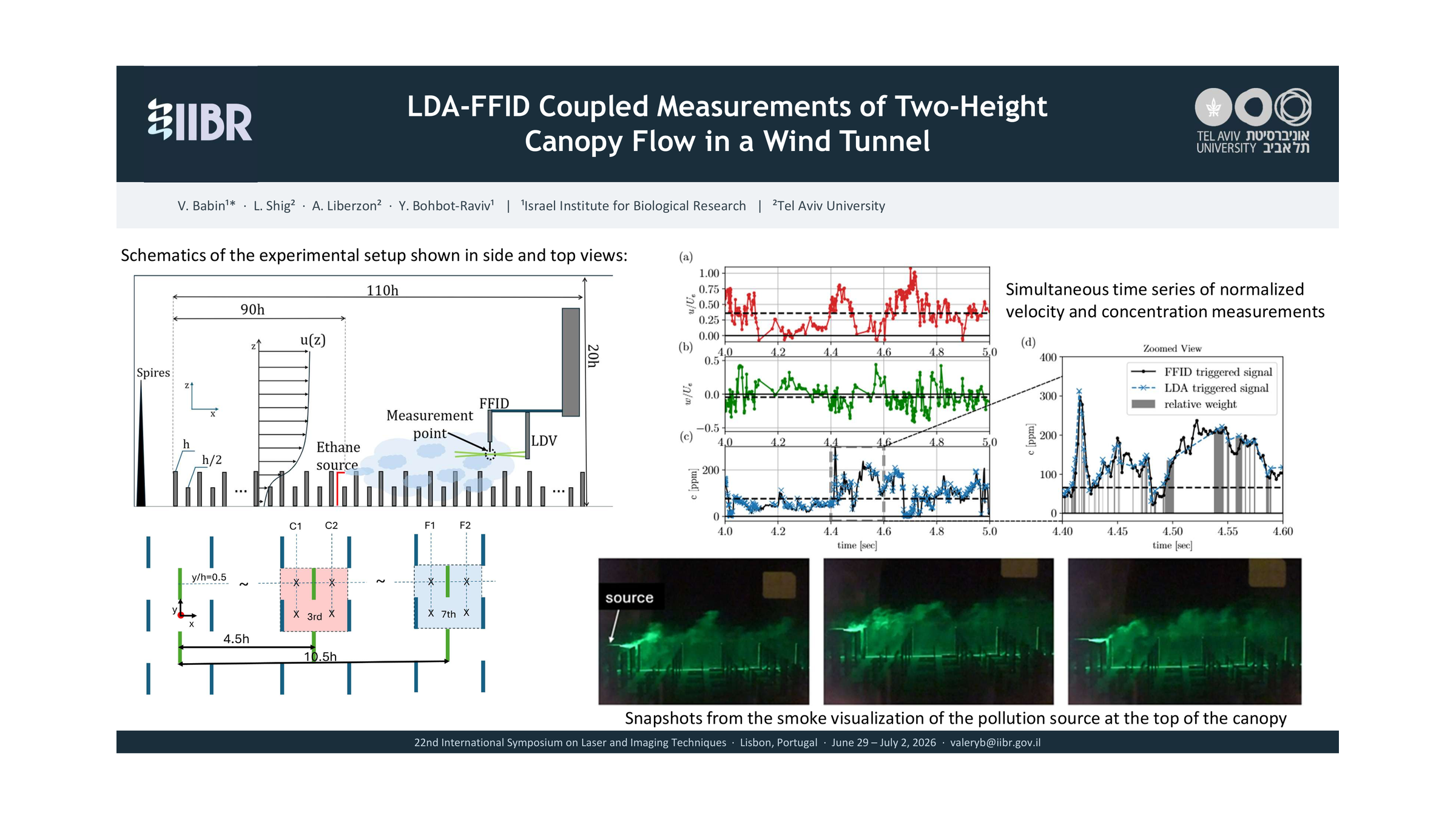
Turbulent scalar exchange between plant canopies and the atmosphere is a critical yet difficult-to-model process. In this study, wind-tunnel experiments were conducted under neutrally stable conditions in an environmental wind tunnel to investigate the vertical transport of a passive scalar released from a localized point source at the top of a two-height canopy. This configuration generates complex flow interfaces distinct from classical elevated sources in turbulent boundary layers. Simultaneous profiles of velocity and scalar concentration were measured using a two-component Laser Doppler Anemometer (LDA) and a Fast Flame Ionization Detector (FFID), respectively. These measurements provide rare, highly valuable experimental data that are crucial for understanding the transport dynamics between the free atmosphere and the canopy. To address the velocity bias inherent to non-uniformly sampled, LDA-triggered measurements, a synchronized acquisition and data processing approach was developed. By applying transit-time weighting, the sampling bias in concentration moments and velocity-scalar correlations was mitigated, reducing discrepancies relative to continuous sampling to less than 3%. Furthermore, an arrival-time quantization method was successfully implemented and validated against uniformly sampled signals, enabling reliable autocorrelation and integral time-scale estimates for spectral analysis. Ultimately, these corrected techniques permit a more physically accurate representation of the S-shaped vertical flux profiles and scalar dispersion behavior unique to the roughness sublayer. Core findings • A synchronized LDA–FFID system was successfully applied for simultaneous velocity and con centration measurements in a highly turbulent canopy flow. • Applying transit-time weighting is crucial for an accurate physical representation of scalar dis persion, reducing concentration-statistics bias from approximately 10% to below 3%. • Simultaneous velocity and concentration measurements enabled the characterization of scalar transport and turbulent scalar fluxes in a two-height canopy flow. • An arrival-time quantization method was validated against continuously sampled measurements, enabling reliable autocorrelation, spectral, and integral time-scale analysis of non-uniformly sampled velocity and concentration signal.