Turbulent boundary layer under a transient change in pressure gradients
K. Zheng, D.W. Carlson, B. Ganapathisubramani
Dept. of Aeronautical and Astronautical Engineering, The University of Southampton, UK
DOI:
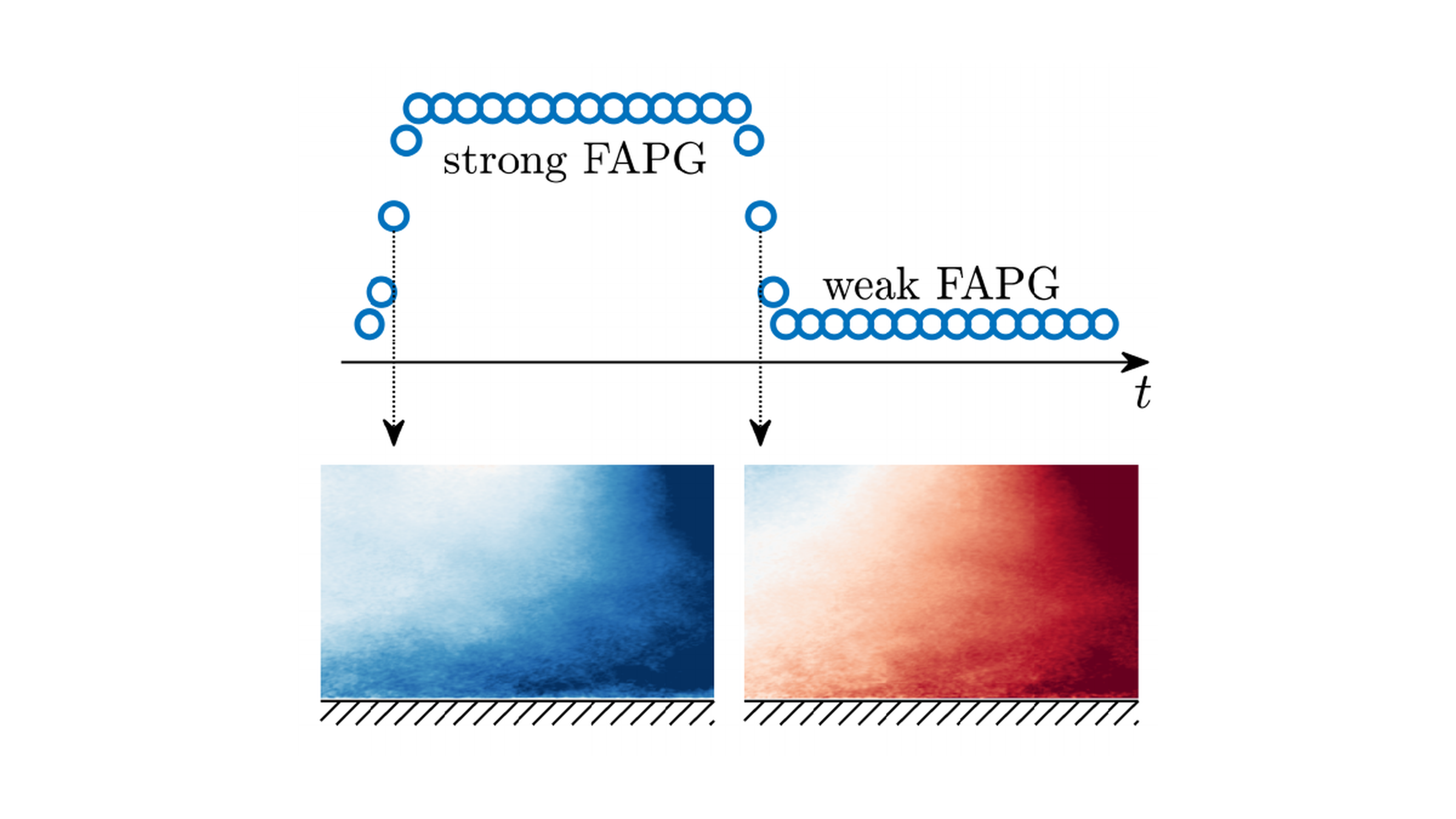
The response of turbulent boundary layers (TBLs) to unsteady pressure gradients (UPGs) is relevant to a wide range of aerodynamic and hydrodynamic applications involving varying flow conditions. While existing studies have primarily focused on steady or periodically varying pressure gradients, the transient response of TBLs following abrupt pressure gradient changes remain largely unexplored. The present study experimentally investigates the evolution of a TBL subjected to transient changes in spatial pressure gradients using planar particle image velocimetry (PIV). Experiments were conducted in a recirculating water tunnel, where a NACA 0012 airfoil was employed to impose favourable to adverse pressure gradient (FAPG) distributions. Two opposite one-way UPG forcing scenarios were examined through controlled pitch-down and pitch-up motions of the airfoil. Three transition rates were considered to assess the influence of UPG forcing dynamic strength. Phase-averaged streamwise velocity statistics were analysed during and after the transient forcing and compared with the corresponding steady-state results to characterize the TBL response and subsequent recovery behaviour. The results show that the boundary layer response depends on both temporal and spatial history effects. In the upstream favourable pressure gradient (FPG) region, the flow responds relatively rapidly to the imposed forcing and approaches the equivalent steady state shortly after the transition. In contrast, delayed adjustment becomes increasingly pronounced downstream under adverse pressure gradient (APG) conditions. Due to accumulated temporal and spatial history effects, an inverse response is observed at far downstream locations, where the transient flow behaviour temporarily opposes the expected steady-state trend. Comparison among different transition rates demonstrates that slower transitions allow the boundary layer to adapt more progressively to the evolving pressure gradient condition, resulting in smaller deviations from the equivalent steady state and faster subsequent recovery. For a rapid transition, the recovery time is shown to depend strongly on the final pressure gradient distribution. While a sequence of weaker FAPGs with relatively mild spatial variation leads to a plateau in recovery time, stronger FAPGs intensifies non-equilibrium effects and prolong the recovery process towards the final steady state.