Vortex distribution and interaction within a perturbed turbulent boundary layer
R. Ribeiro, E.K. Longmire, M.A. Green
Aerospace Engineering and Mechanics, University of Minnesota, USA
DOI:
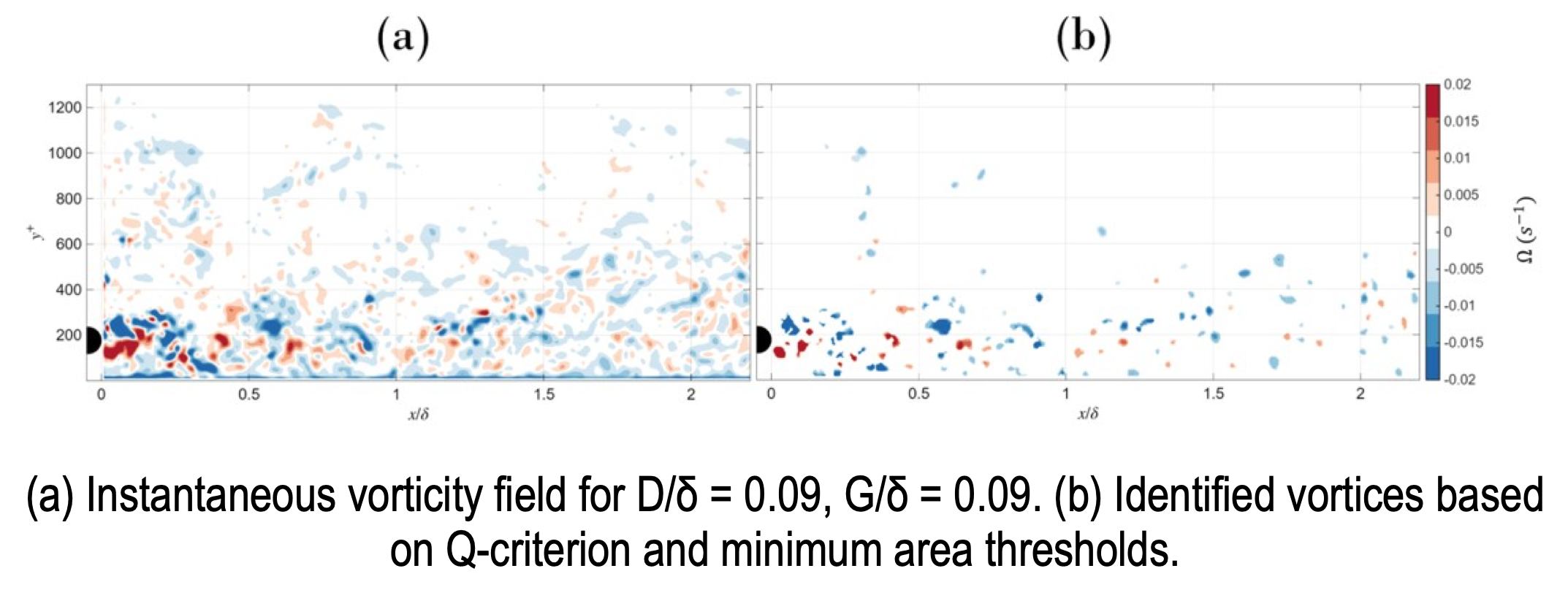
The downstream evolution of coherent vortices generated by cylinders mounted parallel to and above a bounding surface within a turbulent boundary layer was investigated using planar particle image velocimetry (PIV). Experiments were conducted in a recirculating water channel at Reτ = 1470, with cylinder diameters of D/δ = 0.045 and 0.09 and gap heights ranging from G/δ = 0.045 to 0.18. Individual vortices were identified using Q-criterion and minimum area thresholds, enabling quantification of vortex count, circulation, and spatial distribution. In all cases considered, the total number of identified vortices increases strongly downstream of the cylinder and remains above unperturbed levels to the limit of the field of view 2.5δ downstream of the cylinder. Negative (clockwise) vortices consistently outnumber positive (counterclockwise) vortices, reflecting the mean clockwise shear imposed by the wall. The magnitude of the disturbance in mean velocity, turbulent intensity, and number of identified vortices increases with both G/δ and D/δ. In all cases, the wake disturbance extends further from the wall with increasing downstream distance. Comparison between vrms and vortex count profiles shows good correspondence, supporting the interpretation that vortices are key contributors to wall-normal motions.