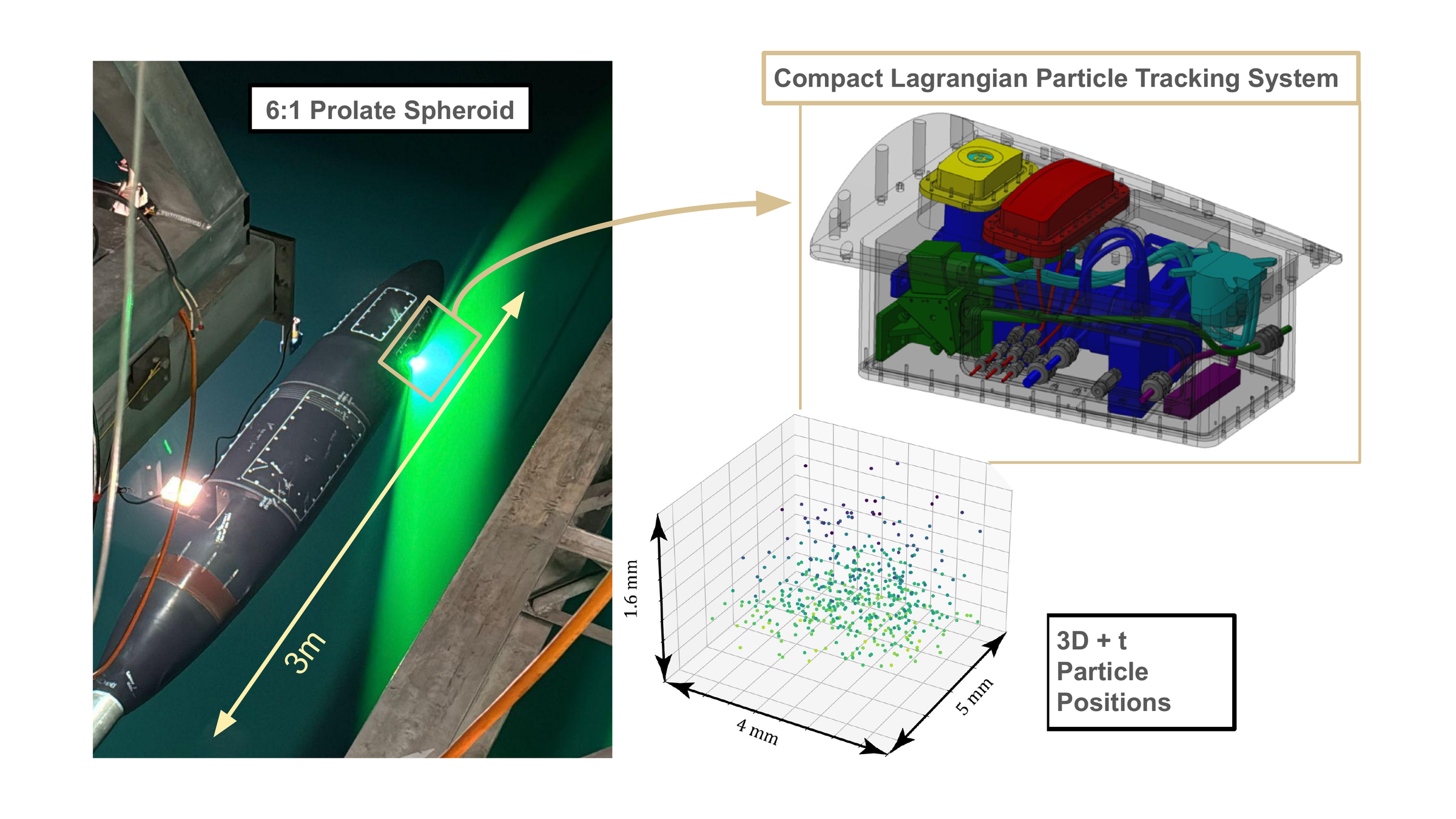
Near-wall 3D Lagrangian particle tracking over a 6:1 prolate spheroid
Y. Sawalhi, C. Fort, M.J. Yamakaitis, P.M. Bardet
Dept. of Mechanical and Aerospace Engineering, The George Washington University, Washington D.C., United States
DOI:
Wall-bounded turbulence is a common problem in fluid mechanics applications. Vessels moving through a fluid at a certain speed will generate a chaotic boundary layer, which can be predicted with computational models. However, there is a need for these models to be validated and improved, which demands near-wall data. This can be achieved through experiments on canonical bodies. Consequently, the High-Reynolds Number Prolate Spheroid (HIPRO) program was developed, with a focus on providing high-fidelity measurements on a 6:1 prolate spheroid. The 3-meter anodized aluminum model can be pitched from 0 to 20° angle of attack and rolled from +180 to −180°, making it an ideal canonical shape to mimic the bodies of vessels typically operated in air or sea. Tests were conducted in a towing tank at the Naval Surface Warfare Center Carderock Division (NSWCCD), with the model submerged at a nominal depth of 5 ft and towed at speeds from 0.03 to 6.17 m/s. The target Reynolds number based on the length ranges from 4.2 × 10⁶ to 12.6 × 10⁶. Compared to previous studies, 12.6 × 10⁶ is an unprecedented test case, which achieves viscous lengthscales below 10 μm. Our goal is to resolve the time-resolved wall shear stress from the velocity gradients within the viscous sublayer. The length and time scales impose stringent resolution requirements. For this reason, the technique we decided to utilize is three-dimensional Lagrangian Particle Tracking (LPT) using a novel, single-camera plenoptic 3.0 imager (Yamakaitis et al., 2025). Polystyrene tracers are locally injected upstream of the measurement region, while a double-head 527-nm pulsed Nd:YLF laser, routed via optical fiber to a custom fiber-optic ring light, provides darkfield illumination up to 1.2 mm away from the surface. The testing spanned a two-week rigging and testing period. Close to 275 test runs were completed, comprising just under 170 TB of data. We currently have preliminary results, including flow visualization of streamlines from various data sets. Due to the complexities in our system, existing LPT software is not suitable for processing the acquired data. Progress of the in-house particle tracking algorithm is denoted.