Fluid–Structure Interaction of a Stented Elastic Straight Vessel
B.H. Johanning-Meiners, D. Krug, M. Klaas
RWTH Aachen University, Chair of Fluid Mechanics and Institute of Aerodynamics, Aachen, Germany
DOI:
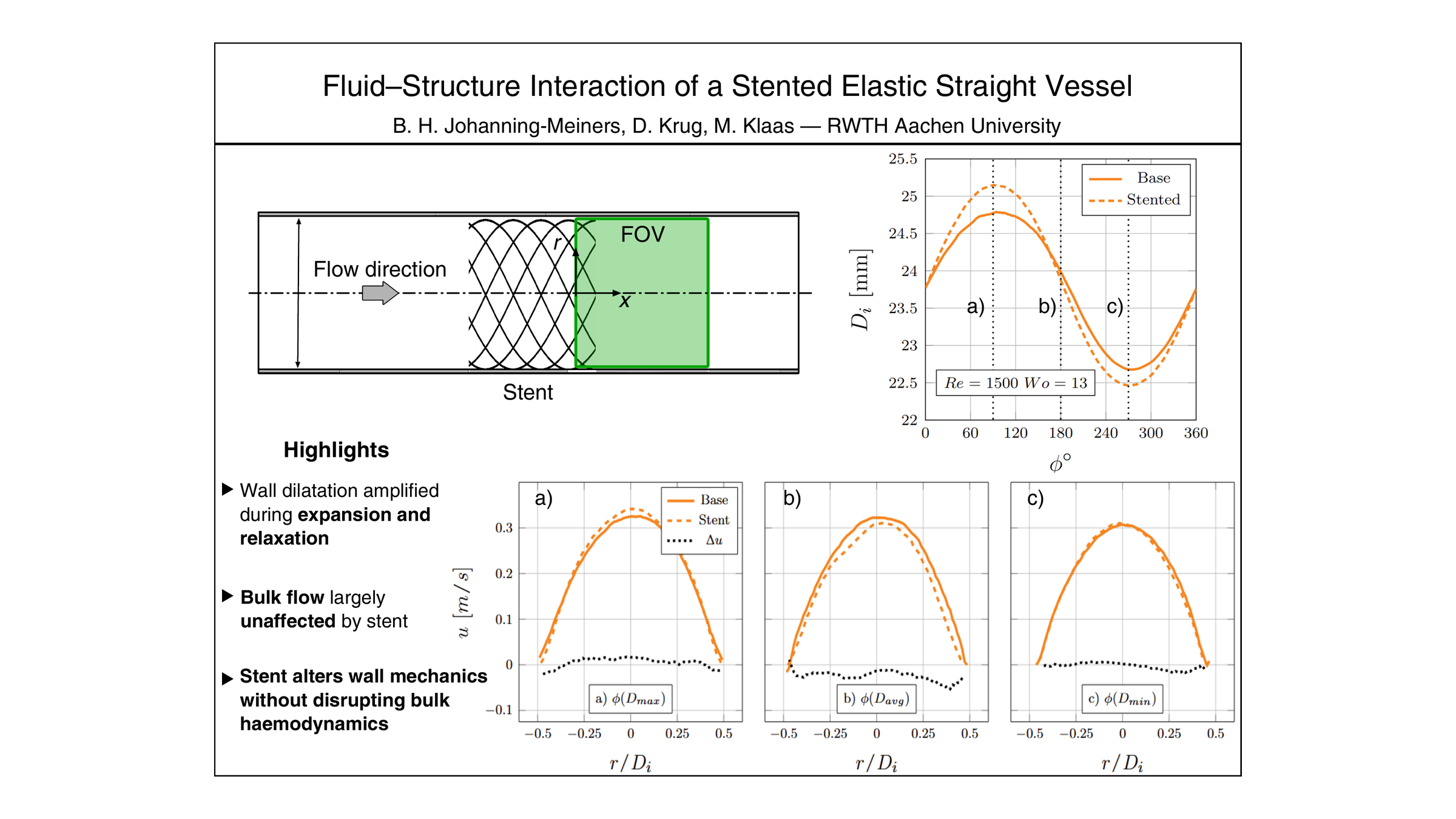
Stent implantation is a widely adopted endovascular treatment for cardiovascular diseases, yet the associated alterations in local haemodynamics and fluid–structure interaction (FSI) remain insufficiently understood, despite their strong links to complications such as restenosis, thrombosis, and delayed occlusion. This study presents an experimental investigation of the flow field and structural response of a stented elastic straight vessel using two-dimensional two-component (2D/2C) particle-image velocimetry (PIV). A silicone phantom with a wall thickness of 1 mm and an inner diameter of D0 = 22 mm was manufactured from polydimethylsiloxane (PDMS) and mounted in an open-loop flow facility with a refractive index matched working fluid. A commercial self-expanding nitinol stent (sinus-XL) with dstent = 24 mm was employed to investigate the effect of stent implantation on the vessel wall dynamics and the bulk flow field. Pulsatile flow conditions covering two Reynolds numbers (Re D = 1000 and Re D = 1500) and three Womersley numbers (Wo D = 13, 15, and 17) were investigated. Analysis of the structural response of the vessel reveals that stent implantation increases the amplitude of pulsatile wall dilatation directly downstream of the stent during both the expansion and relaxation phases of the pulsatile cycle, while leaving the mean inner diameter largely unaffected. Additionally, the stent introduces a temporal shift in the vessel wall motion, with the expansion phase being shortened relative to the unstented configuration. Both the amplitude increase and the phase shift are most pronounced at the lowest Womersley number. The ensemble-averaged velocity profiles measured at x = 0.5 · D0 show that the stent exerts a moderate influence on the bulk flow field, with slightly higher maximum velocities in the stented case at the phase angles of maximum and minimum inner diameter. The results provide new quantitative insight into the coupling between vessel compliance, stent mechanics, and pulsatile haemodynamics, with direct implications for the understanding of stent-related complications such as restenosis and thrombosis in large compliant vessels.