Computational workflow for 2D PTV: validation and application to patient-specific intracranial aneurism phantoms made by additive manufacturing
R. Ré(1,2), G. Albani(1), A. Souza(3), R. Lima(3,4,5), M. Ferreira(2), C. Baccin(6), A. Moita(1)
1: IN+, Center for Innovation, Technology and Policy Research, Instituto Superior Técnico, Universidade de Lisboa, Av. Rovisco Pais, 1049- 001 Lisboa, Portugal;
2: Department of Mechanical Engineering, Escola Politécnica – University of S. Paulo, S. Paulo, Brazil
3: METRICS – University of Minho, Guimarães, Portugal
4: Transport Phenomena Research Center (CEFT), Faculdade de Engenharia da Universidade do Porto (FEUP), Rua Roberto Frias, 4200- 465 Porto, Portugal;
5: Associate Laboratory in Chemical Engineering (ALiCE), Faculty of Engineering, University of Porto, 4200-465 Porto, Portugal.
6: Department of Interventional Neuroradiology – Hospital Beneficência Portuguesa de São Paulo, S. Paulo, Brazil
DOI:
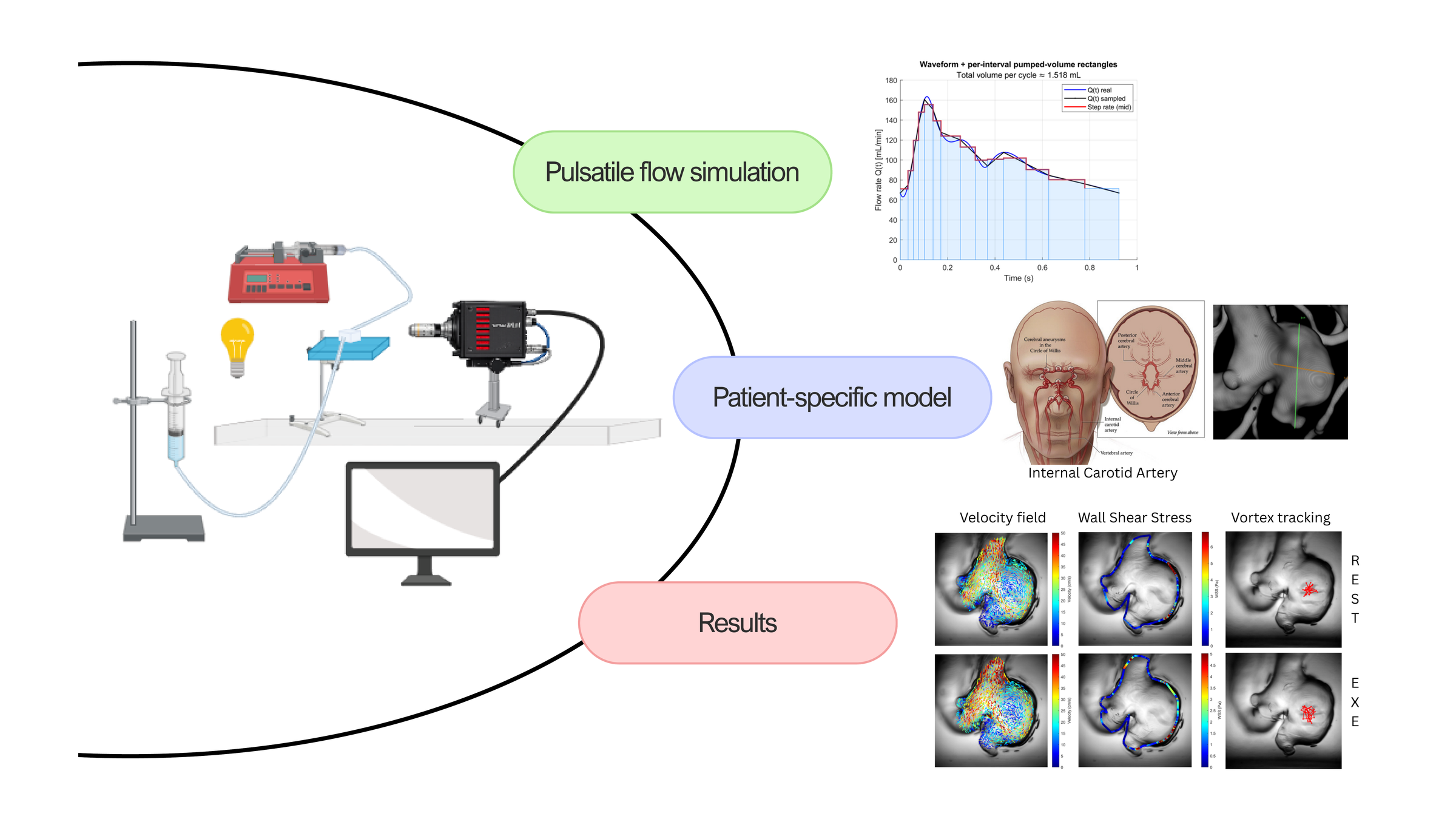
Intracranial aneurysms are pathological dilatations of cerebral arteries associated with potentially fatal rupture events. Although several studies highlighted the importance of hemodynamic factors and aneurysmal geometry in aneurysm formation and rupture, the mechanism is not fully understood. This study introduces a complete and validated computational workflow designed to transform raw 2D PTV images into Eulerian fields for biofluid analysis, which is used to investigate the hemodynamic behavior within patient-specific intracranial aneurysm phantoms assembled by additive manufacturing. A pulsatile flow regime is implemented under both resting and exercise conditions specific for aneurysms in the Internal Carotid Artery (ICA). The results show that, for each case evaluated, the overall flow topology remains generally consistent across the investigated conditions, while significant variations in velocity magnitude, vortex dynamics and Wall Shear Stress (WSS) distribution occur due to changes in flow rate. The exercise condition leads to increased velocity magnitudes, particularly in the outer regions of the primary vortex, resulting in changes in WSS that depend on the flow organization. Furthermore, temporal analysis reveals the migration of vortex structures throughout the cardiac cycle. While Reynolds and Womersley numbers influence vortex dynamics, aneurysm geometry (size and Aspect Ratio) affects vortex stability and aneurysmal flow behavior.