Newtonian vs. Non-Newtonian Blood Mimicking Fluids: A Comparative Study in Context of Mitral Regurgitation Jets
P. Warlitz(1), J. Kriegseis(1), R. Leister(2)
1: Institute of Fluid Mechanics (ISTM), Karlsruhe Institute of Technology, Germany
2: Institute for Modeling Hydraulic and Environmental Systems, University of Stuttgart, Germany
DOI:
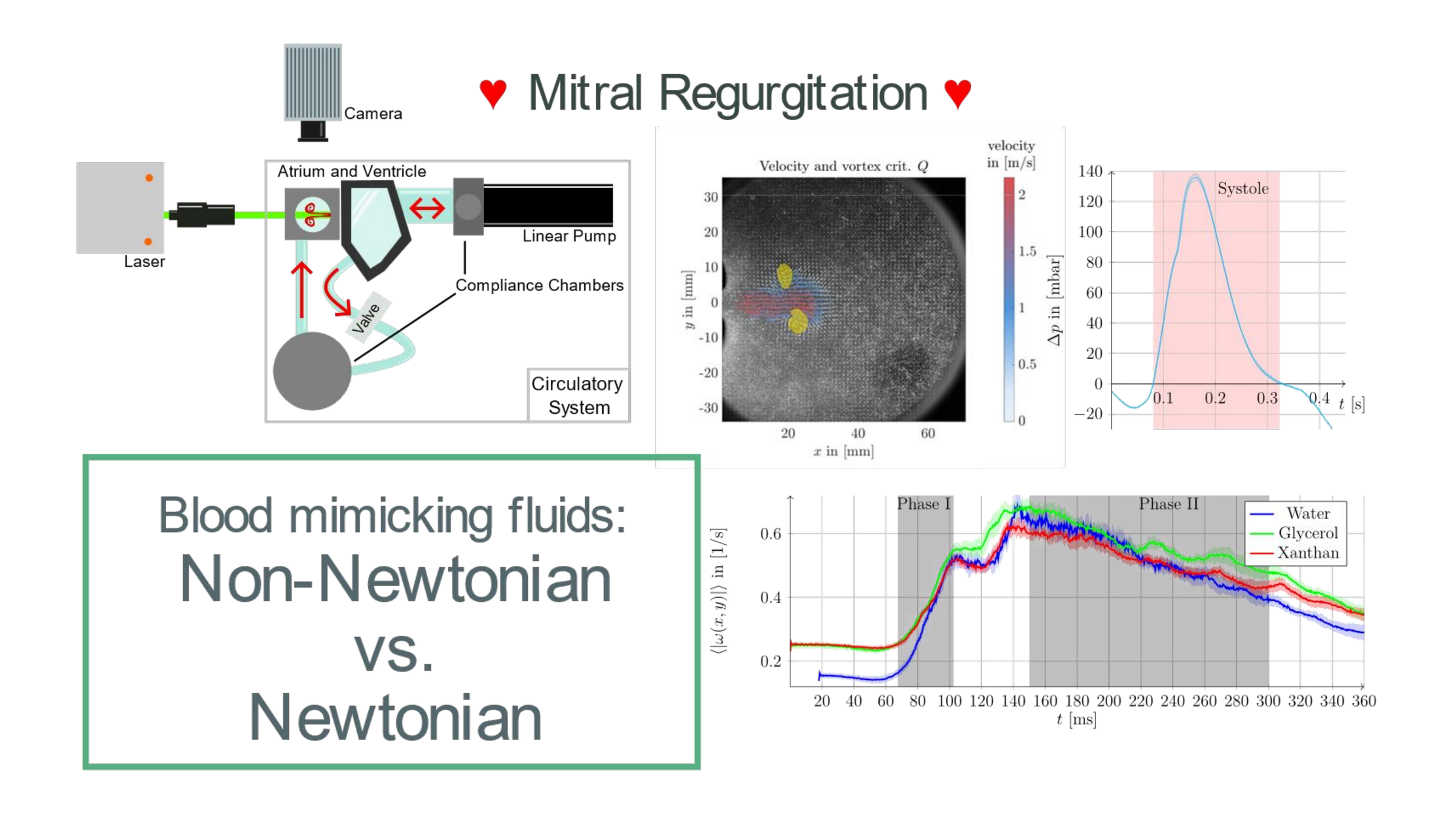
Mitral regurgitation is a prevalent heart valve disease with high incidence rates at higher ages, which, in an aging society, has a significant impact on the health care system. To improve medical diagnostics of mitral regurgitation it is crucial to understand the fluid mechanics of the occurring regurgitation jet, whereas accurate physiological flow modeling in a laboratory in-vitro environment is essential to translate findings to the human cardiac blood flow. Blood exhibits non-Newtonian (NN) behavior, and the importance of the blood-mimicking fluid’s (BMF) ability to replicate this characteristic depends on the flow conditions under investigation. Mitral regurgitation jets are pulsatile, and the flow velocities range from 0 up to 5 m/s, resulting in a broad range of shear rates that challenge Newtonian assumptions. In this work, fluids of various viscosities are compared in a newly-designed experimental setup mimicking the left heart in context of mitral regurgitation. To clarify the influence of viscosity changes on the jet characteristics three fluids – i.e. distilled water, viscosity adapted water-glycerol, and water-glycerol-xanthan-starch as a NN fluid – are used as working fluids. The dynamics of the jet are split into two phases, the starting phase and an ejecting phase. After consideration of mean vorticity, bulk velocity, circulation and shear profiles, it is recommended to consider the NN-behavior of blood in in-vitro mitral regurgitation set ups.