Application of High-Speed Background-Oriented Schlieren (BOS) in Studying Flame-Wall Interaction
S. Kashanj(1), H. Li(1,2), J. Son(1,2), M. Broumand(1), A. Durocher(1), P. Vena(1,3), Z. Hong(1,2)
1: Aerospace Research Center, National Research Council Canada, Ottawa, ON K1A 0R6, Canada
2: Department of Mechanical Engineering, University of Ottawa, Ottawa, ON K1N 6N5, Canada
3: Department of Mechanical Engineering, Polytechnique Montréal, Montréal, QC H3T 1J4, Canada
DOI:
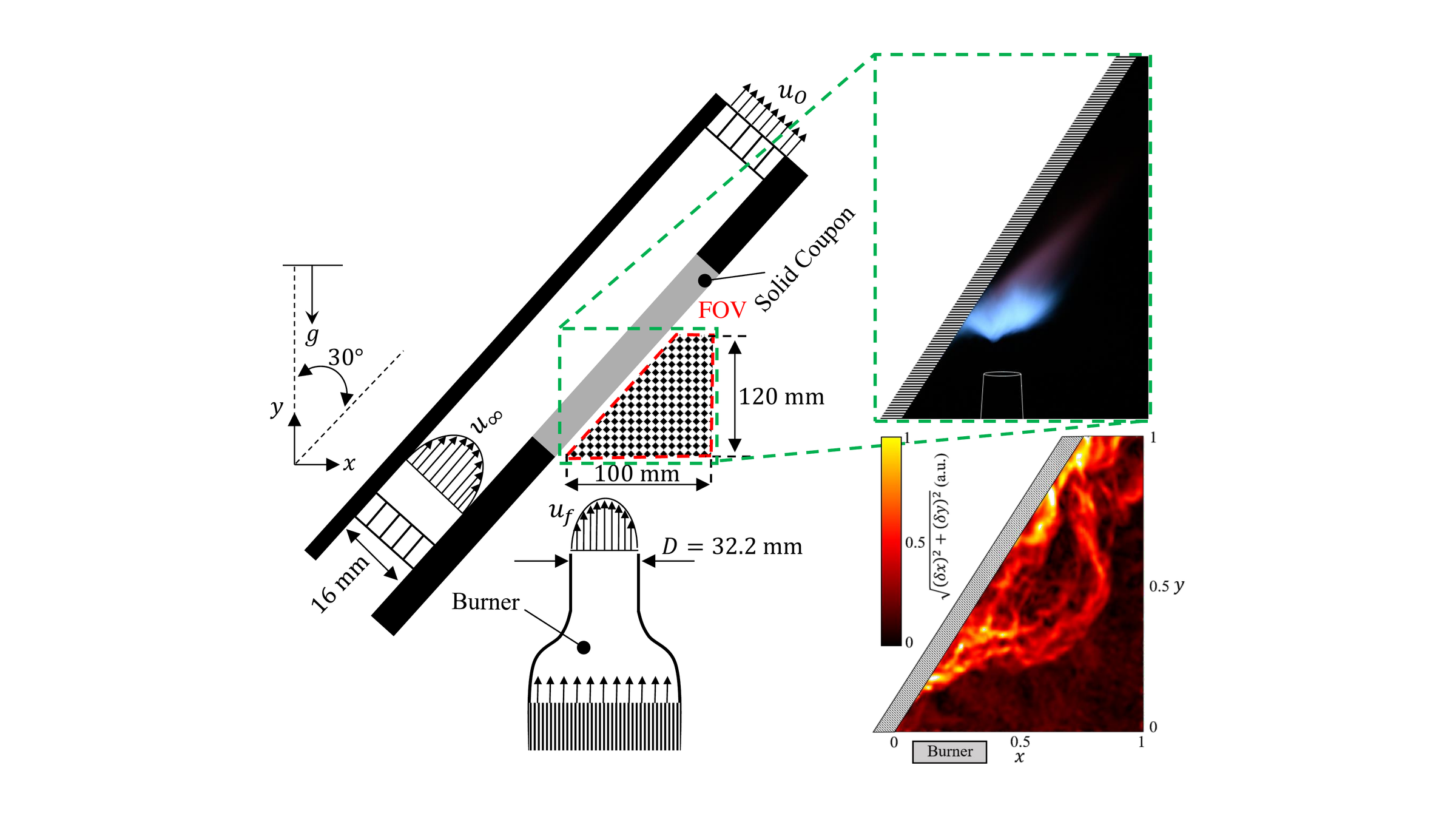
This study presents an application of Background-Oriented Schlieren (BOS) to resolve the near wall refractive index field in flame–wall interactions under high temperature reacting flow conditions. BOS is applied to a low-swirling flame impinging on an internally air-cooled surface inclined at relative to the vertical axis. It was applied to capture density gradient structures associated with thermal boundary layer development without direct temperature measurement. Experiments were conducted in a flame-wall configuration with back-side cooling flow of the wall at Reynolds number of . Adiabatic flame temperatures between and were obtained by varying equivalence ratio for . BOS images were processed using a cross-correlation scheme to extract displacement fields representing line-of-sight refractive-index variations associated with flame–wall interaction and were compared with the OH* chemiluminescence imaging, providing visualization of thermal-field development and regions of heat release. The results demonstrate the capability of BOS to visualize the near-wall flow and temperature structure in high-temperature reacting environments where conventional thermometry is difficult or impractical.