Quantifying spatial-averaging effects in background-oriented Schlieren measurements
A. Hasegawa(1), M. Yamagishi(2), S. Ichihara(1), A. Ishibashi(1), M. Ota(3), Y. Tagawa(1)
1: Department of Mechanical Systems Engineering, Tokyo University of Agriculture and Technology, Japan
2: National Metrology Institute of Japan, AIST, Japan
3: Graduate School of Engineering, Chiba University, Japan
DOI:
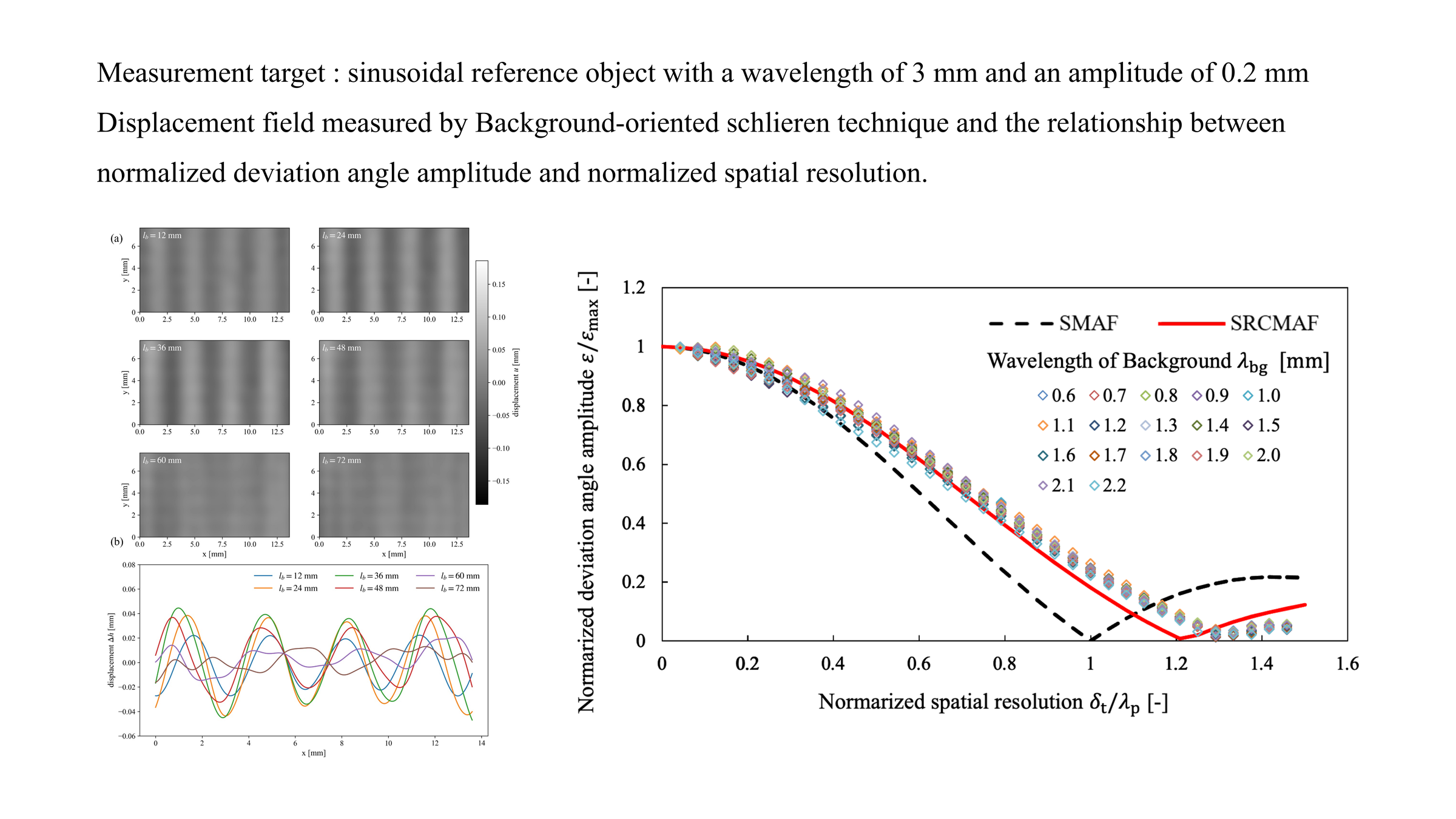
Background-oriented Schlieren (BOS) is a non-contact optical technique for visualizing density-gradient fields from background-image displacement. In quantitative BOS, increasing the background-to-object distance improves sensitivity, but the finite camera aperture also forms a cone-shaped sampling volume on the target. This spatial averaging can reduce the apparent deviation angle, especially for millimeter- and micrometer-scale phenomena. In this study, this spatial-averaging effect was investigated using a sinusoidal reference object with a wavelength of 3 mm and an amplitude of 0.2 mm. A projected BOS system was constructed, and the background-to-object distance was varied while the displacement field was measured using fast checkerboard demodulation. The measured deviation-angle amplitude was compared with theoretical response models. The conventional simple moving average filter captured the overall trend, but quantitative discrepancies remained. To account for the circular aperture of the camera lens, a Simple Radial Circular Moving Average Filter was introduced. This model reduced the maximum discrepancy from approximately 31% to 9%. The results indicate that spatial averaging in BOS should be evaluated relative to the wavelength of the target phenomenon. The proposed model gives a practical criterion: the spatial-resolution diameter should be less than approximately 20.3% of the shortest wavelength to be resolved to keep the deviation-angle error below 5%. Figure 1: Relationship between the normalized deviation-angle amplitude and the normalized spatial resolution.