Effect of angle of attack on the wake dynamics of a delta wing
A. Gururaj, T. Medjnoun, D. Carlson, B. Ganapathisubramani
Dept. of Aeronautics and Astronautics, University of Southampton, United Kingdom
DOI:
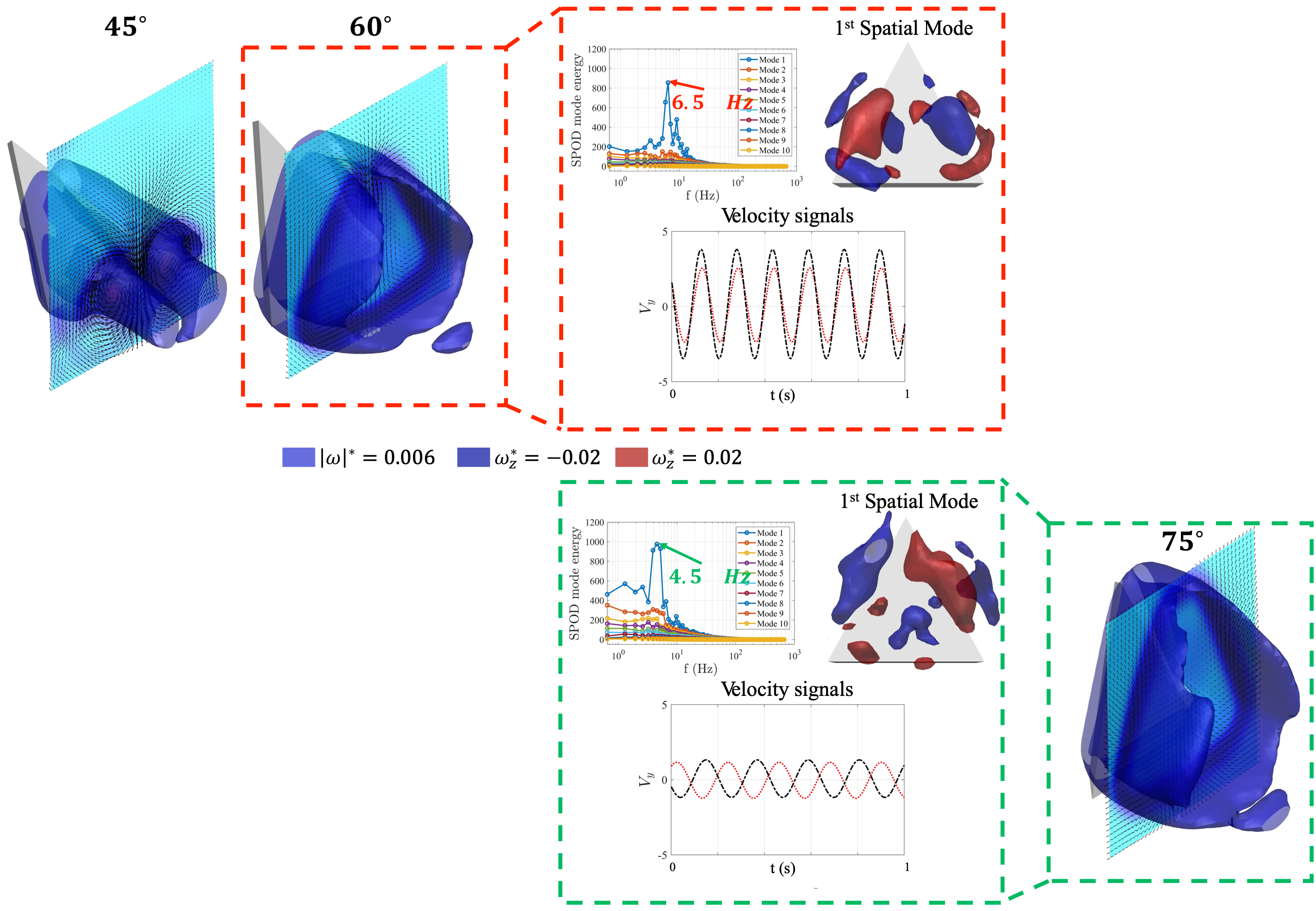
The aerodynamic performance of delta wings is well-documented; however, the spatial mechanisms and energy exchange processes governing vortex shedding at high angles of attack~(α) remain poorly understood because of the limitations inherent in traditional singlepoint measurement techniques. This study addresses this knowledge gap by performing a volumetric experimental investigation into the near-wake dynamics of a non-slender delta wing with a 50° sweep angle. Utilizing three-dimensional (3D) Lagrangian particle tracking velocimetry, the three-dimensional, three-component (3D-3C) flow field was measured at three different angles of attack (α = 45°, 60°, and 75°) at a chord-based Reynolds number of 90000. The time-averaged and instantaneous results reveal a fundamental shift in flow topology: capturing a clear transition from stable, attached leading-edge vortices at 45° to complex periodic vortex shedding at higher α. Spectral proper orthogonal decomposition (SPOD) was employed to isolate the most energetic flow structures, demonstrating that the dominant shedding frequency decreases as the angle of attack increases. By reconstructing the flow field at the dominant frequency and conducting phase-coherence testing, this research provides volumetric confirmation that vortices are shed simultaneously from the wing edges at 60° but transition to an alternate shedding pattern at 75°. Using the bispectral analysis, several triadic interactions between the frequencies are identified, revealing distinct energy transfer mechanisms. It is discovered at 60°, the dominant shedding frequency acts as an energy sink, drawing energy from lower frequencies to sustain coherent structures. On the contrary, at 75°, the dominant frequency acts as an energy source, redistributing energy to lower frequencies and resulting in a more chaotic wake state. These findings demonstrate that the wake of the considered delta wing is a low-rank system governed by specific non-linear interactions. This spatio-temporal characterization provides essential physical insights for the development of future theoretical and predictive models in high angle of attack aerodynamics for delta wings.