Volumetric Flow Field Measurements of a Fixed-Wing Drone in Free-Flight
V.S. Costa, J. Sodja, A. Sciacchitano
Delft University of Technology, Faculty of Aerospace Engineering, Delft, The Netherlands
DOI:
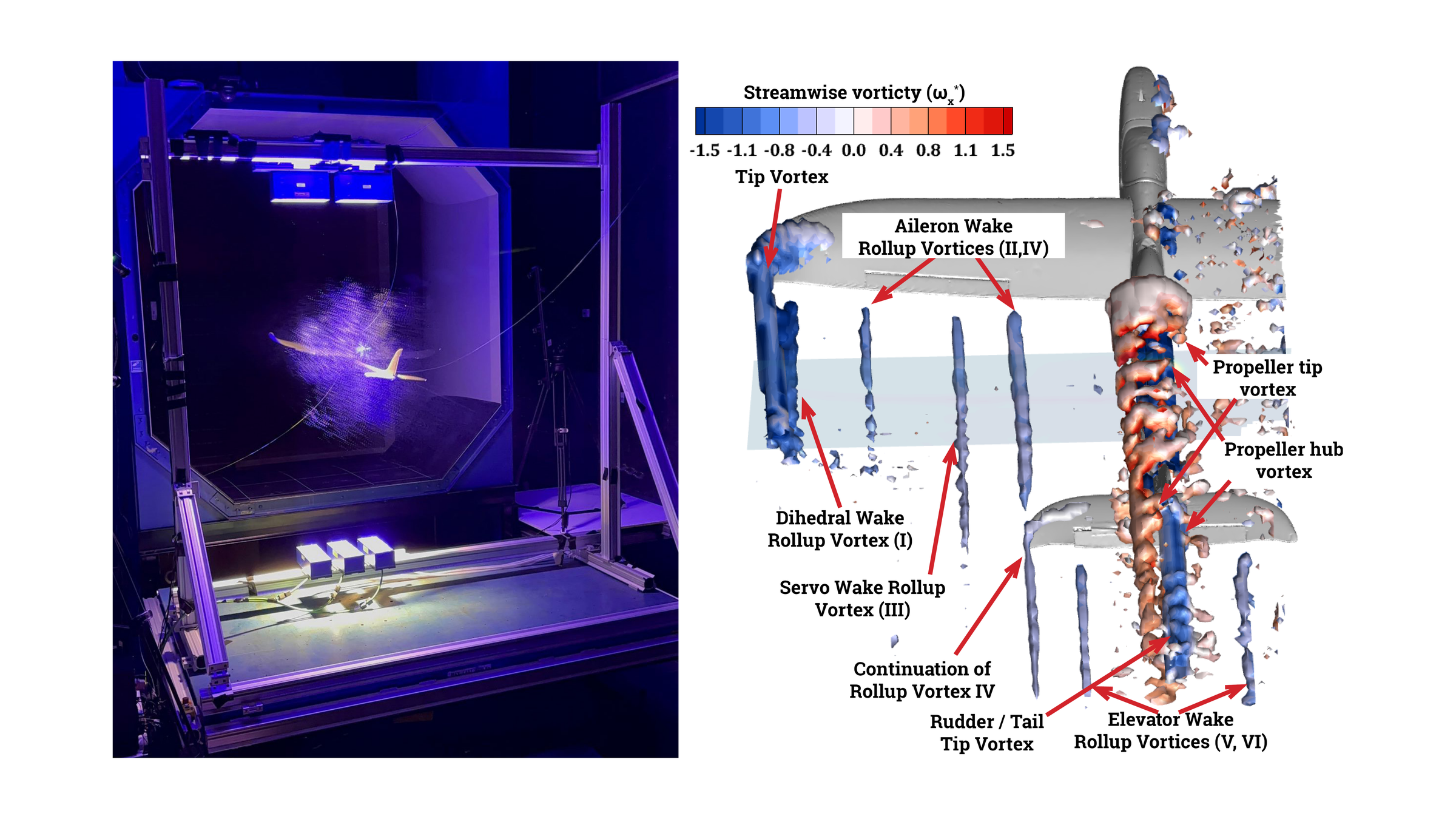
A recent advancement in Lagrangian particle tracking, called Object-Aware Shake-The-Box (OA-STB), has enabled volumetric measurements to be taken with an object obstructing the field of view of the cameras. With OA-STB, complex interactions unique to the flow around free-flying objects can be studied under more realistic conditions than what was previously achievable. To develop a robust strategy for free-flying experiments with OA-STB, measurements were taken on a 1.3m wingspan and 0.977m length model aircraft in levelled free-flight. This was done inside a wind tunnel where the drone was manually controlled and stabilized by an autopilot. Images were acquired using the twelve camera Omni-PIV setup with a volumetric illumination equal to 70 x 80 x 70 cm3. By moving the drone inside the illumination, multiple measurements at different positions were stitched together, giving a measured volume of 0.99m3 within a 0.3 chord radius of the port side of the drone. Three aspects of the experiment are evaluated to assess the capabilities of free-flying measurements and to find areas of improvement. First, the model tracking provided by OA-STB is assessed. The best approach for tracking the drone is ascertained to be using time resolved STB. A partitioned camera system is used to account for the initial camera obstruction. By tracking both surface reflections and markers placed on the model, a positional uncertainty of ±1.6mm and a rotational uncertainty of ±0.28◦ is found. The resulting tracking contained high frequency noise which is filtered out using a Butterworth filter. Secondly, the control strategy is evaluated using the in-flight kinematics of the model. Within a measurement of 4.7s, the attitude varied by up to 0.5◦ from the mean in all components. Similarly, repeated measurements had deviations of the order of 1◦. Significant improvements are required in the control to study specific conditions, as the obtained time average flow field is a mix of many different aerodynamic states. Lastly, an assessment was made of the resulting flow field data. Despite the averaging over multiple states, no discontinuities are observed in the flow field. The obtained data shows the potential of the technique, in this case enabling the characterization of the vortical structures around the wing and the propeller slipstream interaction with the tail.