Phase-locked PIV measurements of an accelerating propeller blade at low Reynolds numbers
M. Ratz(1,2), Y. Lecomte(1,3), C. Schram(1), A. Sciacchitano(4), M.A. Mendez(1,2,5)
1. Environmental and Applied Fluid Dynamics Department, von Karman Institute for Fluid Dynamics, Belgium
2. Aero-Thermo-Mechanics Laboratory, École Polytechnique de Bruxelles, Université Libre de Bruxelles, Belgium
3. Service d’Automatique et d’Analyse des Systèmes, École Polytechnique de Bruxelles, Université Libre de Bruxelles, Belgium
3. Faculty of Aerospace Engineering, Delft University of Technology, The Netherlands
4. Experimental Aerodynamics and Propulsion Lab, Universidad Carlos III de Madrid, Av. de la Universidad 30, 28911 Leganés, Spain
DOI:
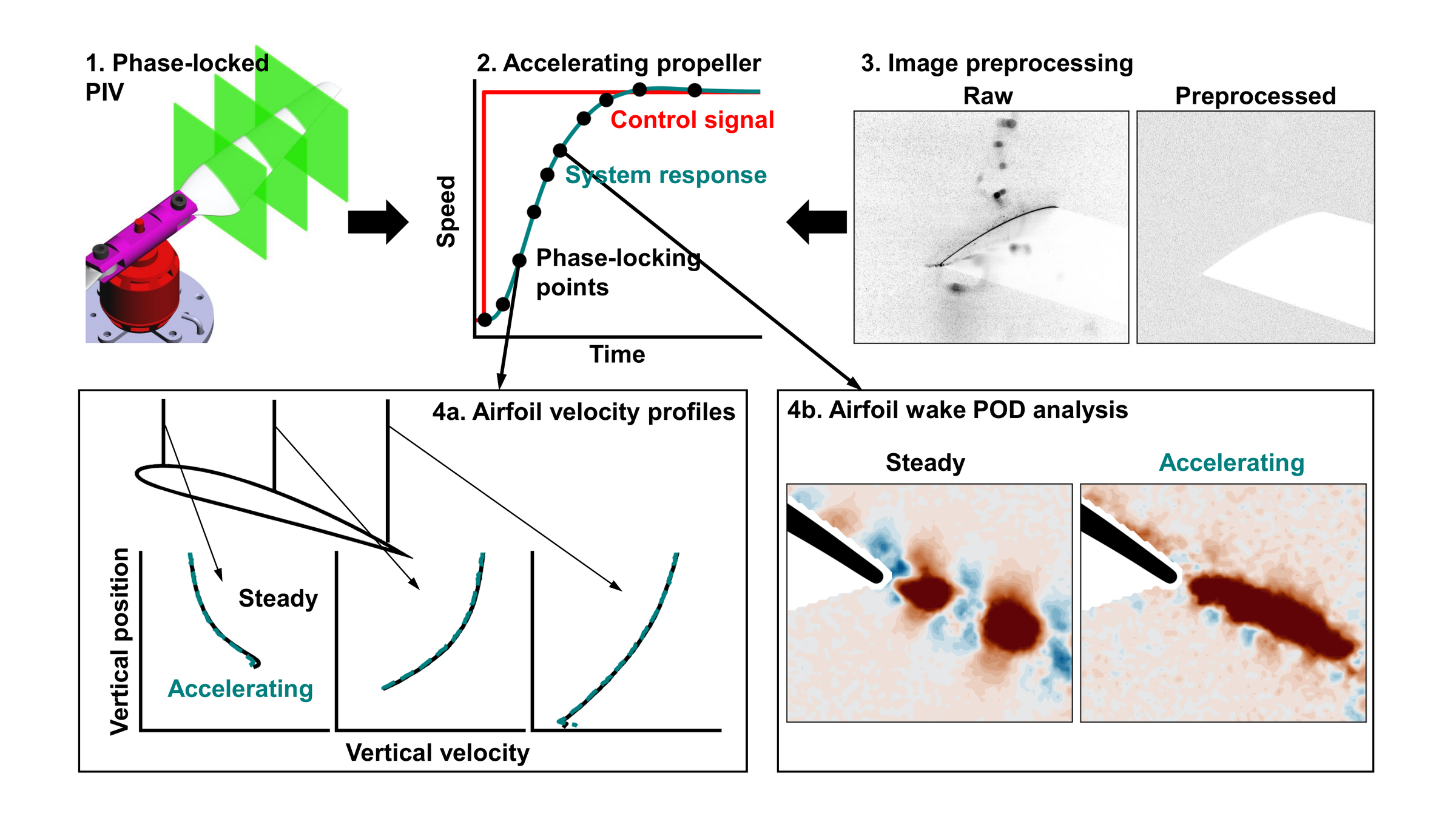
This study investigates the transient aerodynamic response of an accelerating small-scale propeller for unmanned aerial vehicles, operating at low Reynolds numbers (104-105). In this flow regime, the flow over the blade can have laminar separation and vary between being reattached and staying separated at different rotational speeds. Between these two states, the flow response to rapid changes in the rotational speed is still poorly understood, as most studies focused on 2D airfoils, not entire propellers. Experiments were conducted in a low-speed wind tunnel using the rotor blades of a commercially available 10-inch propeller. The pitch of the blades was increased by 10% to mimic higher pitch configurations or the flight envelope of a variable pitch rotor. The propeller disk was placed normal to the oncoming flow, and open-loop step responses of the speed control signal were carried out between rotational speeds where the flow was attached or separated. The rotor response was characterized with thrust load cell and phase-locked particle image velocimetry (PIV) measurements. Data were gathered in quasi-steady conditions at fixed rotational speeds and during the transient acceleration. The thrust measurements show hysteresis, with a maximum difference in the generated thrust of up to 10% during the moment of strongest acceleration. As a byproduct of the required PIV pre-processing, information about the structural dynamics was recovered, including the out-of-plane deflection and additional twist due to blade loading. While a slight hysteresis is present in accelerating conditions, it seems too small to affect the generated thrust. Vertical velocity profiles extracted over the blade show no hysteresis in the flow field, at least within the resolution of the current PIV setup, even after extensive pre-processing. To further quantify differences, we analyze the airfoil wake through a proper-orthogonal decomposition and compare the leading mode in quasi-steady and unsteady conditions. Results show differences in the wake shortly after the moment of the biggest differences in the thrust coefficient, indicating that changes near the surface of the blade are advected downstream with a small delay.