Investigation of the dynamics of coherent structures downstream of delta winglet pairs using Proper Orthogonal Decomposition analysis
L. Heraoua(1), S. Hamidouche(1), M. Meldi(2), S. Russeil(1)
1:IMT Nord Europe, Institut Mines Telecom, Univ. Lille, Center for Energy and Environment, F-59000 Lille, France
2: Univ. Lille, CNRS, ONERA, Arts et Metiers ParisTech, Centrale Lille, UMR 9014 - LMFL - Laboratoire de Mecanique des Fluides de Lille - Kampé de Fériet, F-59000 Lille, France
DOI:
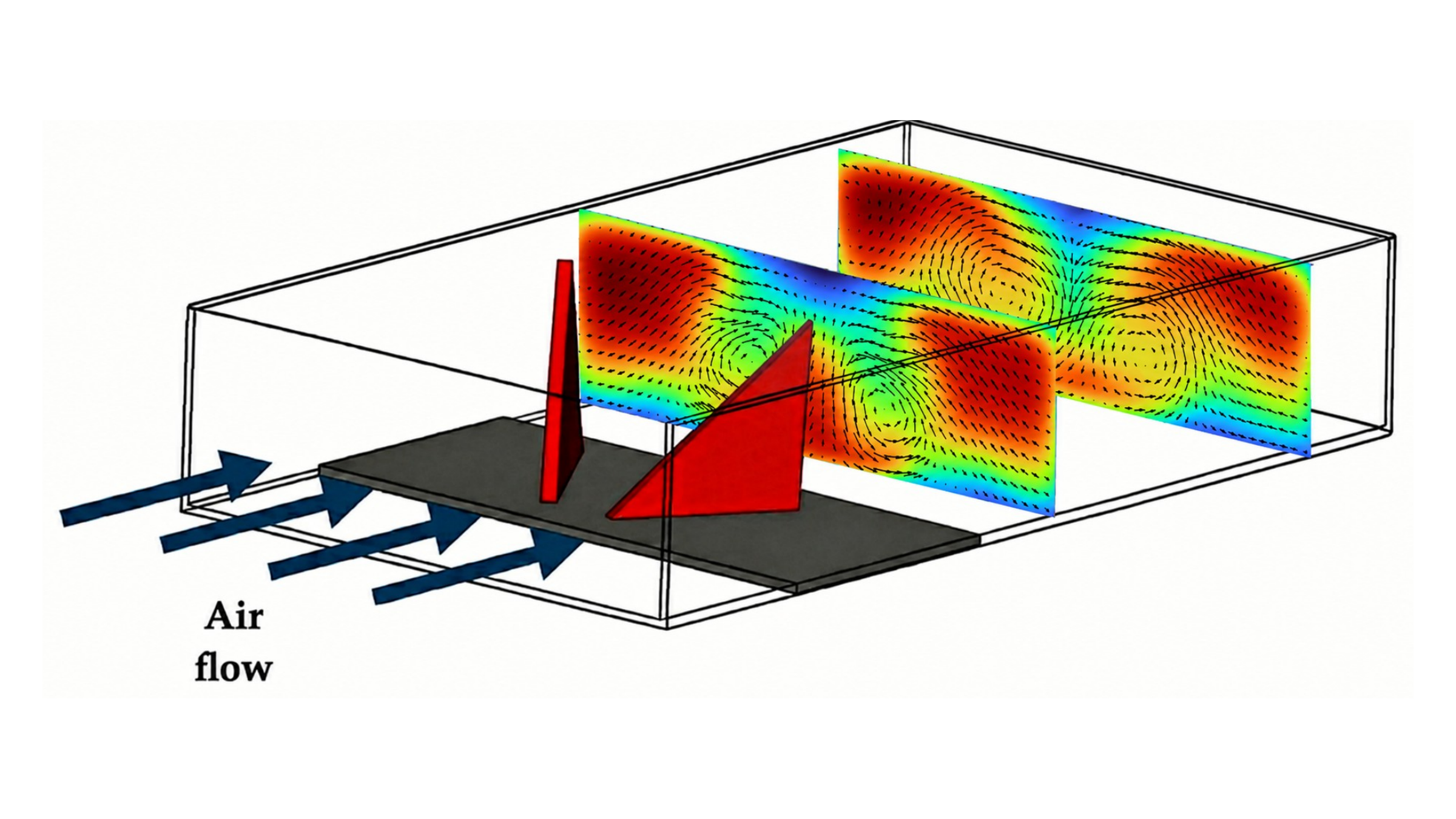
The present study experimentally investigates the flow downstream of a delta winglet pair vortex generator mounted in a rectangular channel. Snapshot Proper Orthogonal Decomposition is applied to Stereoscopic Particle Image Velocimetry measurements acquired in two transverse planes downstream of the vortex generator, located at three and six channel heights. Two Reynolds numbers are considered, 800 and 12000, representative of transitional and turbulent regimes, respectively. The analysis focuses on the modal decomposition of coherent flow structures, the energy content of the leading modes, their spatial organization, and the spectral behaviour of their temporal coefficients. The results show that both Reynolds number and downstream evolution away from the vortex generator affect the modal energy distribution and the organization of the leading modes. In the transitional case, the cumulative energy of the first two modes decreases from 31.5 percent near the vortex generator to 18.3 percent farther downstream, indicating a reduced dominance of the leading coherent structures. In the turbulent case, the first two modes contain a much lower fraction of the fluctuating kinetic energy, decreasing from 9.8 percent to 7.3 percent between the two measurement planes. The spatial modes support this trend: the transitional near-wake case exhibits the clearest low-order coherent organization, whereas the turbulent case shows less clearly paired structures. For the transitional case near the vortex generator, the phase portrait and the common spectral peak of the first two temporal coefficients support the presence of a paired low-frequency oscillatory motion. These results provide experimental insight into the modal decomposition of coherent flow dynamics induced by delta winglet pairs.