Modal decomposition of actuated wingtip vortices by a pulsating active control in a 2D3C-PIV system
M. Garrido-Martin(1), P. Gutierrez-Castillo(1), F.J. Blanco-Rodríguez(2), A.J. Hijano(1), C. del Pino(1)
1: Institute for Mechatronics Engineering and Cyber-Physical Systems (IMECH.UMA), Universidad de Málaga, Spain
2: Área de Mecánica de Fluidos, Departamento de Ingeniería Aeroespacial y Mecánica de Fluidos, Universidad de Sevilla, Spain
DOI:
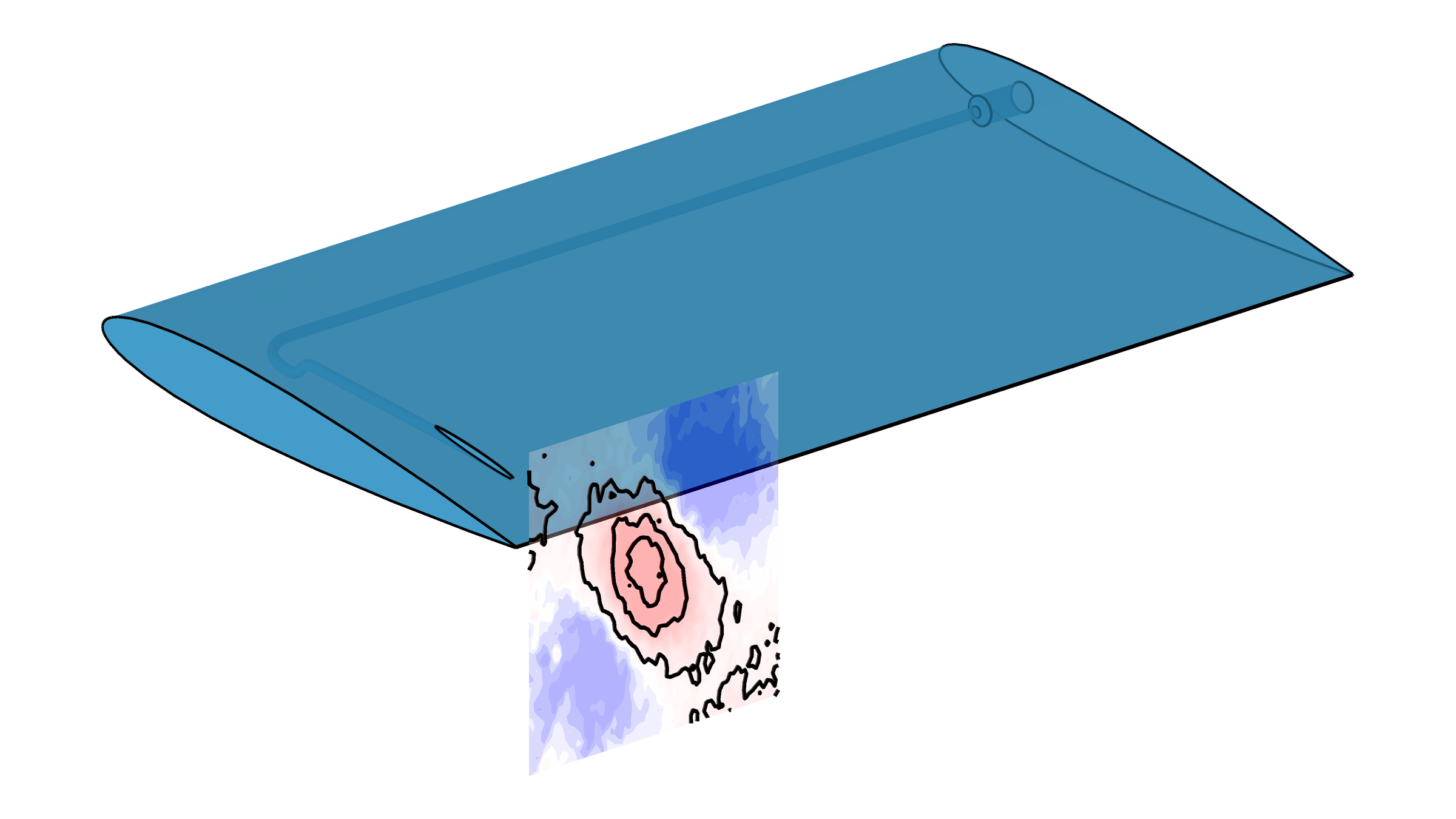
The reduction of wingtip vortex strength generated by aircraft is a key objective in modern aeronautics, as the persistence of these rotating flow structures represents a potential risk to flight safety and drives operational restrictions in air traffic management. An experimental active control based on a pulsating synthetic jet is proposed to reduce the strength of wingtip vortices. The pulsating injection supports the interaction with the intrinsic modes of the vortex, for which a correct determination of its governing parameters, such as frequency and location, is critical. The proposed experiments are performed using a 10-meter water towing tank at the Laboratory of Aero-Hydrodynamics at the University of Málaga. A synchronized 2D3C-PIV system is used to obtain the full velocity field of the actuated wingtip vortices. Several pulsating actuations are tested, measuring the effectiveness of the proposed active control in the evolution of maximum streamwise (axial) vorticity and the dissipation rate of the wingtip vortices. Modal-based decomposition techniques such as POD and HODMD are applied as complementary tools to extract the dominant structures (energetic and unstable) and the associated temporal dynamics from the experimental data.